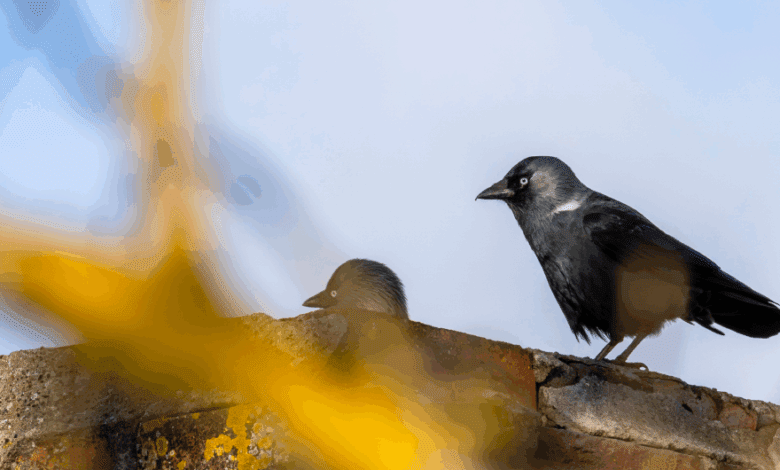
In the bustling world of birds, where noise and chatter never subside, jackdaws (Corvus monedula) display a remarkable ability: females can unerringly recognize their partner’s call even in the busiest colonies. A new study by British biologists sheds light on how these birds navigate complex social structures and why it is so crucial for them to respond instantly to certain signals.
During experiments conducted in Cornwall, scientists recorded the unique contact calls of males and played them back to females while they were incubating their eggs. The birds’ reactions were not only distinct—they were strikingly fast if the call came from a long-term partner. On average, females turned toward the sound source within two seconds, while responses to calls from other familiar or unfamiliar males were noticeably slower.
A voice like a passport
Corvids, which include jackdaws, have long been known for their intelligence and complex social bonds. However, it remained unclear how acutely they can distinguish individual voices. It turns out that, for jackdaws, a partner’s voice is more than just a sound—it’s like an audio passport that cannot be faked. Even in colonies with dozens of birds, each female can unfailingly pick out the right signal from all the background noise.
Interestingly, females responded to the calls of unfamiliar males with a noticeable delay—on average, after seven seconds. When the signal came from a colony neighbor, the pause increased to ten seconds. In some cases, the birds ignored unfamiliar voices altogether, but they almost always reacted instantly to their partner’s call.
Experiment in detail
To ensure the experiment’s accuracy, researchers used loudspeakers mounted at the entrances of nest boxes. The birds became accustomed to these devices in advance so they wouldn’t be startled during the experiment. Each female listened to three types of calls: from her own partner, from a familiar male in the colony, and from a completely unfamiliar male.
Reactions were recorded using video surveillance. In most cases, females turned toward the nest entrance, sometimes peeked outside, and occasionally even left the nest. However, the speed of the initial reaction turned out to be the main indicator: the closer the relationship with the male, the faster the response followed.
The social life of jackdaws
Jackdaws are monogamous birds that form stable pairs for several seasons. In dense colonies, where dozens of conspecifics are constantly around, the ability to recognize ‘one’s own’ becomes vital. This skill helps not only in raising offspring but also in defending the nest from competitors and predators.
Scientists note that similar individual recognition skills are found in other species as well, such as African penguins, which recognize their partners by unique patterns on their chests. However, for jackdaws, the main identifier is the voice, which is especially important in low-visibility conditions inside nest boxes.
Memory and intelligence
It was already known that jackdaws are able to remember human faces and even associate them with specific events, such as danger. The new research confirms that their cognitive abilities also extend to distinguishing the voices of other jackdaws. This opens new horizons for studying corvid social dynamics and communication.
In a quarter of cases, the females would peek out of the nest after the signal, and sometimes even leave it to make sure it was safe. However, this behavior did not depend on whose voice they heard—what mattered more was the speed of their initial reaction.
In case you didn’t know, jackdaws (Corvus monedula) are members of the corvid family, widely distributed across Europe, including Spain. These birds are known not only for their intelligence but also for their ability to engage in complex social interactions. In Spain, jackdaws are often found in cities and rural areas, where they form large flocks and display impressive adaptability to different environments. Studies like this one help us better understand how these birds live and why they thrive in such a wide variety of ecosystems.