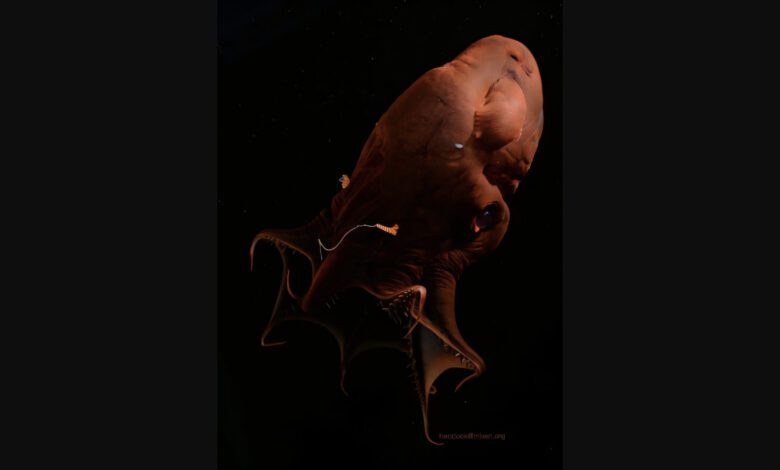
The depths of the ocean conceal many mysteries, and for a long time the vampire squid (Vampyroteuthis infernalis) was one of them — a rare cephalopod that thrives in extreme environments. This unusual marine creature combines features of both octopuses and squids, and its appearance and behavior astonish even seasoned biologists. A recent study by an international team of scientists has, for the first time, fully decoded its genome — a real breakthrough in the study of cephalopod origins.
Researchers from Japan, Austria, and Germany used cutting-edge sequencing techniques to obtain the most accurate map yet of this creature’s genetic code. They found that the vampire squid’s genome is not only enormous — over ten billion base pairs — but also uniquely structured and preserved from ancient times. This discovery offers a new perspective on the evolution of squids and octopuses, and sheds light on the key genetic changes in the history of these animals.
A marine relic with unique traits
The vampire squid is the only surviving member of the vampyromorph order, which first appeared on Earth during the Mesozoic era. Its body, reaching up to 30 centimeters in length, is covered with numerous photophores—glowing organs that help it camouflage in dark waters. This mollusk has the largest eyes relative to body size among all animals, and their ability to reflect light in various shades makes it almost invisible to predators.
The vampire squid lives in the oxygen minimum zone—an area of the ocean where oxygen levels are so low that most other cephalopods cannot survive. It is highly adapted to these extreme conditions: it reproduces rarely, lays only a few large eggs, and females brood their offspring for more than a year. Because of these traits, the vampire squid is considered a living fossil, retaining features of its ancient ancestors.
Genetic mystery: what DNA analysis revealed
Sequencing of the vampire squid’s DNA was carried out using PacBio HiFi technology, which makes it possible to read long segments of the genome with high accuracy. The data showed that this mollusk’s chromosomal structure is closer to squids and cuttlefish than to octopuses. Unlike octopuses, which have undergone massive rearrangements and chromosome fusions, the vampire squid has retained a karyotype characteristic of more ancient cephalopods.
Researchers have discovered that 62% of the Vampyroteuthis infernalis genome is made up of repetitive elements, mainly long retrotransposons (LINEs). Despite their abundance, the genetic structure has remained relatively stable, setting this mollusk apart from its closest relatives. Additionally, the vampire squid retains rudimentary limbs, a reminder of its kinship with decapod squids.
Cephalopod evolution: new perspectives on origins
A comparative analysis of the genomes of the vampire squid, squids, octopuses, and argonauts led scientists to a key conclusion: the ancestral chromosomal organization of all modern cephalopods is closer to that of squids rather than octopuses. This means squids, not octopuses, have preserved more features of their common ancestor. Major genome rearrangements in octopuses have formed the basis for their unique intelligence and complex behavior.
This discovery sheds light on how major genetic changes can give rise to new life forms and adaptations. Scientists believe that further study of the vampire squid genome will help unravel evolutionary mechanisms not only among mollusks, but also in other animals, including mammals.
The future of research and the significance of the discovery
Decoding the genome of Vampyroteuthis infernalis opens new horizons for biology and genetics. Researchers can now more accurately trace the evolutionary paths of cephalopods and study how genetic changes influence brain development, behavior, and morphology. This is especially important for understanding molecular processes in various animal groups.
In the coming years, scientists plan to continue working with the genome of the vampire squid to uncover more details about its biology and evolution. The new findings are expected not only to reveal the secrets of ancient marine creatures, but also to expand our knowledge of genetic adaptation mechanisms to extreme environments.
RUSSPAIN Fact Sheet: What is the vampire squid?
The vampire squid (Vampyroteuthis infernalis) is a rare species of cephalopod found at depths of 600 to 900 meters in tropical and subtropical seas. It was first described in 1903 by German zoologist Carl Chun, who mistakenly thought it was an octopus. This mollusk has a unique anatomy: eight arms connected by a web and a body covered in luminous organs. It feeds mainly on detritus and zooplankton, and thanks to its unique adaptations, it survives where other cephalopods cannot. Today, the vampire squid is considered one of the most mysterious and least studied inhabitants of the deep ocean.