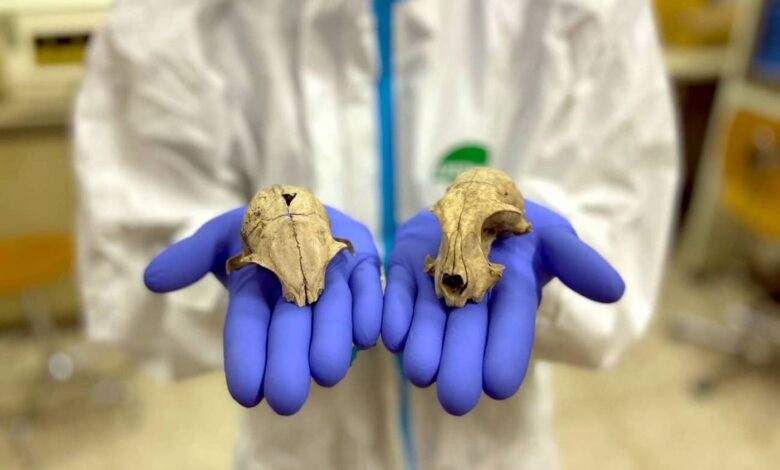
For a long time, it was believed that domestic cats accompanied the first European farmers from the very beginning of their journey. However, new genetic research has completely changed this picture. It turns out that the familiar felines only arrived on the European continent much later than archaeologists and biologists had previously thought.
For millennia, images and cat bones have been found at archaeological sites across Eurasia and North Africa. These discoveries pointed to a close relationship between humans and these animals. But bones alone couldn’t determine whether the cats were wild or already domesticated. The skeletons of domestic and wild members of the Felis genus are almost indistinguishable in structure, which long prevented scientists from pinpointing exactly when domestication began.
Genetic discoveries
Previous theories were mostly based on the analysis of mitochondrial DNA, which is passed down exclusively through the maternal line. These results led to the belief that cats arrived in Europe from Asia Minor with Neolithic farmers about 6,000 years ago. However, modern sequencing techniques have allowed scientists to look at the issue from a new perspective.
An international team of paleogeneticists conducted a large-scale study, analyzing the complete nuclear genomes of 70 ancient cats found at archaeological sites across Europe and the Middle East, as well as 17 modern wild specimens. This approach made it possible to trace not only maternal, but also paternal lineages, and to identify instances of interbreeding between different populations.
European roots
The analysis yielded unexpected results. Cats that lived in Europe during the Neolithic belonged to the native species Felis silvestris—the European wildcat. They were not related to the Felis lybica lineage, from which modern domestic cats descend. This means that the earliest farmers did not bring domesticated animals with them, as previously assumed. The local wildcats occasionally interacted with people, but remained independent and never became pets.
Genetic traces of true domestic cats appear in European samples only about 2,000 years ago. This period coincides with the height of the Roman Empire, when trade and sea travel reached unprecedented scales. It was then that cats from North Africa began to actively spread throughout Europe.
The Mediterranean route
DNA analysis has revealed that modern domestic cats are most closely related to North African wildcats native to Tunisia and Morocco. Their genetics differ from the Levantine populations, which were previously believed to be the main ancestors of domestic cats. It is likely that sailors and traders crossing the Mediterranean became the primary “carriers” who introduced cats to new territories.
Of particular interest is the cat population on the island of Sardinia. Here, descendants of an ancient migration wave from North Africa—dating back about 2,200 years—have been discovered. These animals have preserved unique traits of their ancestors and are genetically distinct from domestic cats that later spread across mainland Europe.
Historical parallels
The spread of cats across Europe was linked not to the advent of agriculture, but to the development of maritime routes and trade networks during antiquity. Unlike dogs, which humans took with them from the earliest times, cats only became human companions with the onset of a new era. Their appearance in European homes coincided with the flourishing of trade, urbanization, and the expansion of cultural contacts.
Thus, the history of domestic cats in Europe is not just a biological story but also a cultural saga, closely tied to the development of civilization, seafaring, and commerce. Each new genetic analysis uncovers unexpected chapters in this history, prompting us to rethink established views of the past.
If you didn’t know, Felis catus is the Latin name for the domestic cat, one of the world’s most popular pets. Modern cats are descended from the North African wildcat (Felis lybica), which can still be found in Tunisia and Morocco. In Europe, wildcats belong to a separate species—Felis silvestris—which differs in both behavior and genetics. Today, cats are found on every continent except Antarctica and play an important role in human life as companions and rodent hunters.