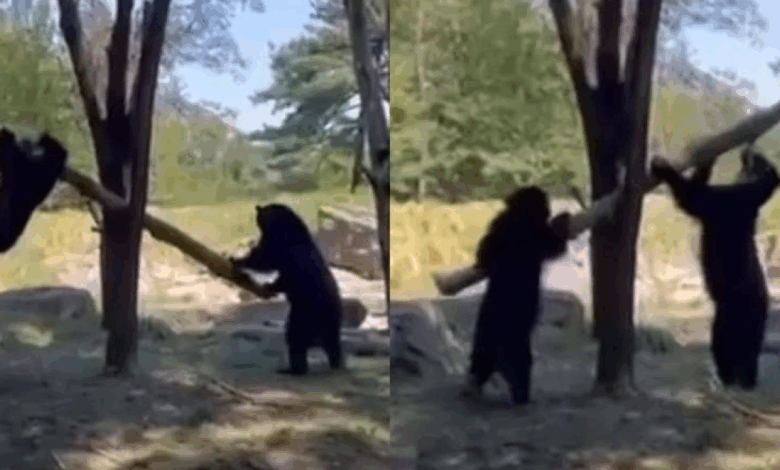
At one of New York’s most famous zoos — Queens — visitors witnessed an unexpected scene: a pair of young spectacled bears turned an ordinary log into a real swing. A two-year-old female named Koya and an almost four-year-old male Ransiscu, who share the same enclosure, showed remarkable ingenuity. Their playful antics attracted the attention not only of zoo guests but also of staff, who watched the events unfold with genuine interest.
In a video captured by a visitor, both bears can be seen taking turns rocking the log, which is secured in the fork of a dry tree. Koya took the left side, while Ransiscu settled on the right. At one point, the male begins to lower his end of the log, lifting his partner into the air, just like on a real swing. The spectacle was so unusual that many could hardly believe their eyes.
Play and behavior
Spectacled bears, known for their caution and elusive lifestyle, rarely display this kind of activity in public. This time, however, the animals seemed eager to put on a real show. Their interactions with objects in the enclosure are frequently studied by animal behavior specialists. Such games not only entertain the bears themselves but also promote their physical and mental development.
Zoo staff note that such displays of playful behavior are a sign of the animals’ well-being. In captivity, these moments are especially valuable as they indicate that the bears feel comfortable and are not experiencing stress. For visitors, it’s a rare opportunity to witness moments from the lives of wild predators, who in nature tend to keep to themselves.
Public reaction
The video of the bears playing quickly spread across social media, sparking a wave of discussion and enthusiastic comments. Many users noted that such footage lifts the mood and offers a new perspective on these predators. Some even compared the behavior of Koya and Ransisku to children playing on a playground.
For the zoo, these moments are a great opportunity to draw attention to its residents and remind the public of the importance of conserving endangered species. Spectacled bears, native to South America, are under threat of extinction, and every instance of their successful adaptation in captivity is cause for celebration among specialists.
Scientific significance
Observing the behavior of spectacled bears in a zoo setting allows scientists to draw important conclusions about the animals’ needs and characteristics. Playful activity, interacting with objects and with each other—all of this helps to better understand how to provide them with proper care. In addition, such observations can be valuable for conservation and reintroduction programs aimed at returning the species to the wild.
In recent years, experts have increasingly used video surveillance and behavioral analysis of animals to develop new habitat enrichment methods. Creative solutions, such as installing swings or other unconventional objects, are becoming part of a comprehensive approach to zoo animal welfare.
Interesting details
Spectacled bears (Tremarctos ornatus) are the only bear species native to South America. Their distinctive feature is the light patches around their eyes, which resemble eyeglasses and give the species its name. In the wild, these animals are mostly solitary, and encounters between individuals are rare.
In a zoo environment, bear behavior can differ greatly from what is observed in the wild. Playing together, interacting with objects, and even displaying care for each other become possible thanks to attentive care and the creation of a comfortable environment. For specialists, such moments offer valuable material for further research.
RUSSPAIN.COM reports that the environmental organization Wildlife Conservation Society, which manages the Queens Zoo, is involved not only in animal care but also in implementing international programs to conserve rare species. The organization conducts scientific research, supports educational initiatives, and collaborates with zoos worldwide. Spectacled bears are one of the priority species for WCS specialists, and each successful case of their adaptation marks an important step towards preserving biodiversity.