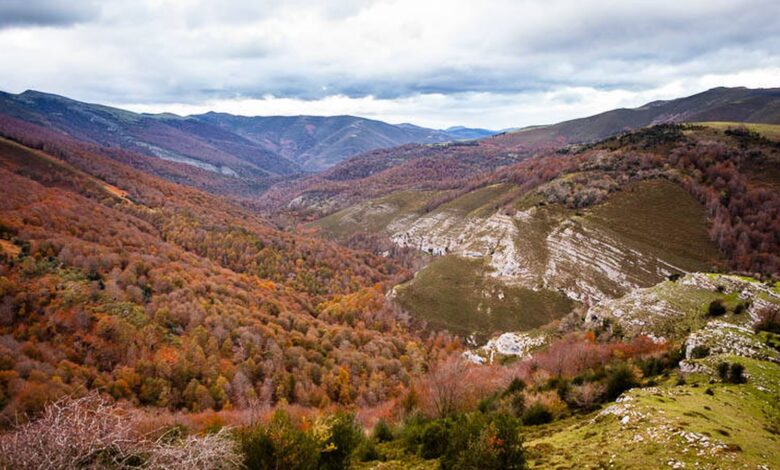
Far from the beaten tourist paths, in the very heart of Cantabria, lies the largest protected natural area in the region. This is a place where time seems to stand still. Spanning more than 24,000 hectares, it preserves some of the most precious and ancient forests on the entire Iberian Peninsula. It is here, in these misty valleys and gentle mountain slopes, that one of Spain’s rarest and most iconic birds—the Cantabrian capercaillie—has found its last refuge, now on the brink of extinction.
Saja-Besaya Park is not just a territory—it is a living organism, where beech and oak groves reign supreme. The silence feels almost tangible, broken only by the rustling leaves and the murmuring of countless streams. This world, shrouded in moist mist, guards secrets that reach back to the Ice Age. And here, in its most secluded corners, you can still hear the mating song of the capercaillie—a symbol of untouched wilderness and the health of the entire forest ecosystem.
The Forest Heart of Cantabria
Officially established in 1988, Saja-Besaya Nature Park became a shield for a unique area of immense ecological, geomorphological, and scenic value. Its forests, including more than 6,000 hectares of oak groves and vast beech woodlands, make up one of the largest continuous expanses of forest in the Cantabrian Mountains. This green ocean is home to emblematic species such as deer, wild boar, the Iberian wolf, and the wildcat, as well as over one hundred species of nesting birds.
But the park’s true hidden gem, known to few, is its significance in conserving the Cantabrian capercaillie. Saja-Besaya marks the easternmost habitat of this bird across the entire mountain range. This forms a remarkable biological anomaly, making the park a critical enclave for the species’ survival. The presence of the capercaillie is a reliable indicator of a forest’s maturity and health, as only in such conditions can it successfully reproduce.
Trails and History
The park is exceptionally well-equipped for visitors, featuring numerous marked hiking trails, six rest areas, and an information center for a deeper understanding of the local ecosystem. One of the top attractions is the La Cardosa viewpoint. Here, a monument to the roe deer greets visitors, offering a breathtaking panorama of mountains, valleys, and forests, which are transformed beyond recognition during the autumn deer rut.
In addition to its natural wealth, the park is home to just one settlement—the historic-Barcena Mayor complex. This mountain village, with its perfectly preserved traditional architecture, serves as a gateway to a wild and tranquil world, where nature still truly reigns.
How to Get There
There are several ways to enter the park. From Cabezón de la Sal, take the CA-180 highway, or from Mazcuerras, follow the CA-812 towards Cabuérniga until you reach Ucieda, one of the main entrances. Another option is to start from Reinosa, drive along the CA-183 to Espinilla, then turn onto the CA-280 towards the Puerto de Palombera pass.
An alternative route runs along the Besaya River via the national N-611 highway, which connects Reinosa to Torrelavega. Along the way, there are turnoffs to the villages of Villayuso or Los Llares, both located very close to the park. From here, popular hiking trails begin, such as the ascent to Braña del Moral or to the rest area of Praducos.
RUSSPAIN Reference. The Cantabrian capercaillie (Tetrao urogallus cantabricus) is an endemic subspecies found only in the Cantabrian Mountains in northern Spain. It is listed in the Red Book as critically endangered. Compared to its European relative, it is smaller, has darker plumage, and possesses distinct genetics. The main threats to this population, whose numbers have dropped drastically in recent decades, are habitat destruction, human disturbance, and climate change.