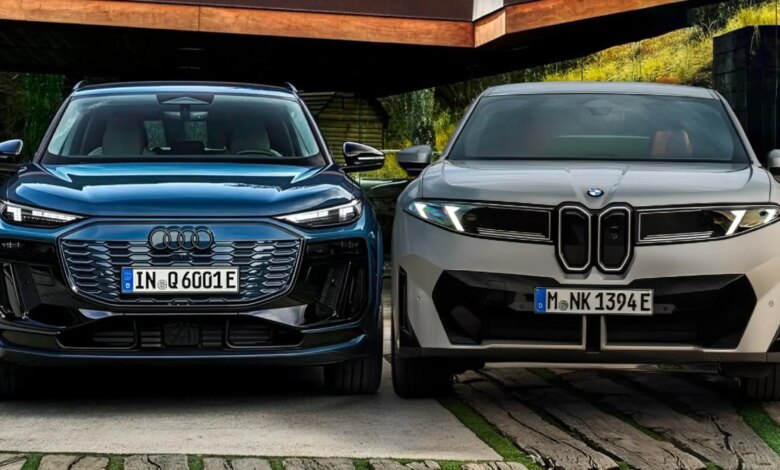
Two German giants, BMW and Audi, find themselves on opposite sides once again, but this time their rivalry is unfolding in the world of electric SUVs. In the spotlight are the newly launched BMW iX3 and the Audi Q6 e-tron, which has already found a loyal following. Both vehicles represent a new era for their respective brands, where the focus is on sustainability, innovation, and prestige. But which one truly deserves to be called the best choice for those seeking luxury and cutting-edge technology in a single package?
Comparing these models, it’s clear just how much automakers’ priorities have shifted. While past battles were fought over power and comfort, today the key factors are driving range, charging speed, and digital capabilities. And although both SUVs look like they’re straight out of the future, each comes with its own strengths and weaknesses.
Exterior
The BMW iX3 immediately stands out with a fresh visual concept that will set the tone for the brand’s entire new lineup. Its design is bold, distinctive, and even a bit provocative—exactly the impression Munich designers intended. Meanwhile, the Audi Q6 e-tron sticks closer to tradition, preserving the brand’s signature features. For fans of classic styling, that could be a decisive factor.
Interestingly, Audi offers not only the standard version but also the Sportback—a more dynamic silhouette that adds a sporty touch. This approach broadens the appeal and lets buyers choose a crossover that fits their tastes.
Dimensions and Interior Space
Both vehicles belong to the D-segment SUV class and are nearly identical in size. The BMW iX3 is slightly longer, while the Audi Q6 e-tron is wider and taller. The difference in trunk capacity is minimal: Audi offers 526 liters, BMW 520. In everyday use, this is unlikely to be decisive, but for perfectionists, every detail matters.
The wheelbase of both models is nearly the same, promising a similar level of comfort for passengers. Inside, both crossovers provide spacious cabins and thoughtfully designed ergonomics, but the BMW feels fresher thanks to its updated design solutions.
Technical specifications
This is where things get interesting. The BMW iX3 is currently available in just one version—the xDrive 50, featuring two electric motors and an impressive 469 hp. It accelerates to 100 km/h in just 4.9 seconds, and its official driving range reaches 805 km. With a 108.7 kWh battery and fast charging support up to 400 kW, this crossover is a real long-distance champion.
Audi Q6 e-tron, on the other hand, is offered in four different versions. The base model is rear-wheel drive, delivering 292 hp and a range of 544 km. More advanced options—Performance, quattro, and SQ6 e-tron quattro—feature increased power, all-wheel drive, and different dynamic characteristics. The top-end SQ6 sprints to 100 km/h in 4.4 seconds but has a slightly lower range of 585 km. For most buyers, however, this is more than sufficient.
Prices and trim levels
Premium status and electric technology inevitably affect the price. The Audi Q6 e-tron starts at €66,370, while the BMW iX3 begins at €69,900. The difference isn’t critical, but for some buyers it may tip the scales towards the Audi. However, it’s worth noting that the base BMW is noticeably better equipped: 20-inch wheels, a digital instrument cluster, advanced driver assistance systems, heated seats, and smartphone integration all come standard.
Audi’s entry-level Advanced trim also offers plenty of attractive features: 19-inch wheels, sports seats, LED lighting, keyless entry, and advanced mirrors. But if you want more, you’ll need to pay for additional packages.
A choice without compromise
Comparing these two crossovers, it’s clear: the BMW iX3 excels in range and power, while the Audi Q6 e-tron stands out for its variety of versions and slightly lower price. For buyers looking for maximum range and rich standard equipment, the BMW is the stronger option. But if you value the opportunity to customize your car and save at purchase, the Audi won’t disappoint.
In any case, both vehicles set a high bar for the competition and demonstrate that German automakers aren’t giving up ground in the new electric era. Each model is compelling in its own way and is sure to impress even the most discerning driver.
RUSSPAIN reminds readers that BMW is one of Germany’s oldest and most respected automakers, founded in 1916. The company is renowned for its engine and design innovations, as well as its ongoing pursuit of excellence. Audi, meanwhile, is part of the Volkswagen Group and known for pioneering technologies, high production quality, and meticulous attention to detail. Both brands consistently rank among the leaders in the global automotive market.