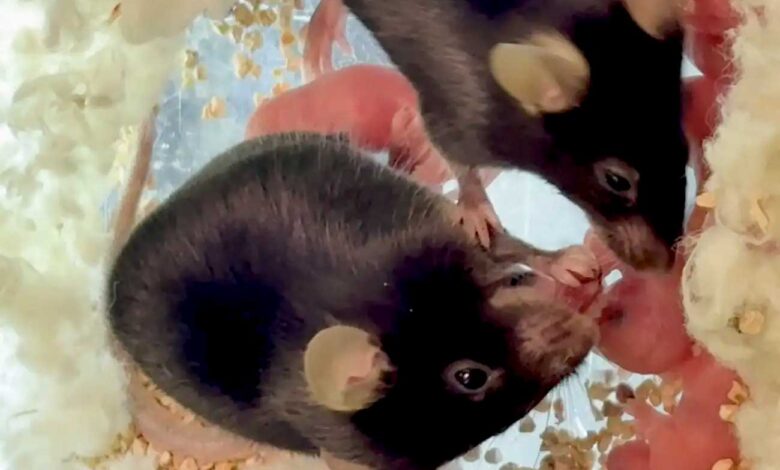
Surprising discoveries: how mice help each other during childbirth. For a long time, support during birth was considered a uniquely human trait. Humans often face complications during delivery, so assistance became part of our culture. However, new observations of rodents challenge this belief.
Previously, such behavior had been observed only in certain primates, such as snub-nosed monkeys (Rhinopithecus) and bonobos (Pan paniscus). Among other mammals, these kinds of actions were thought to be rare. Typically, animals prefer solitude during such moments to protect themselves and their offspring from threats.
Despite their social nature, mice have long remained outside the focus of researchers on this question. The reason is the difficulty of observation: rodents give birth in shelters, and their activity peaks during nighttime. This has made it challenging to study their behavior in natural conditions.
Laboratory experiments: how rodents rescue their peers
A team of researchers from the USA led by Robert Froemke of the Langone Medical Center at New York University accidentally captured an unusual scene. During experiments studying the brain activity of birthing females, scientists noticed that other mice were actively interacting with them and sometimes providing real help.
To test the hypothesis, researchers conducted special experiments using pregnant mice with deactivated oxytocin receptors—the hormone responsible for uterine contractions. Without it, the pups often became stuck in the birth canal, posing a threat to both the mother’s and the offspring’s lives.
The animals were divided into two groups. In the first, each pregnant mouse was accompanied by an experienced female who had previously given birth. In the second group, the pregnant mice were left alone. If complications arose, the experienced neighbors helped: they gently pulled the pups out with their paws and teeth, then tore open the amniotic sac so the newborns could breathe.
The results were impressive: out of ten females with helpers, nine survived and almost the entire litter remained alive. In the group without support, nearly all the pregnant mice died; only one managed to survive childbirth along with her offspring.
The Role of Experience and Social Bonds in Offspring Survival
Scientists set out to determine how important maternal experience is for providing effective help. In a new experiment, pregnant mice lacking oxytocin receptors were divided into three groups: with males, with females who had never given birth, and with females who also lacked oxytocin.
In every case, the neighbors tried to support the mothers. The males applied pressure to the back, helping to push the pups out, while the inexperienced females licked and massaged the abdomen. However, only the experienced females knew how to tear open the amniotic sac—a step that is crucial for the pups’ survival.
In these groups, the mothers had higher survival rates, but not a single pup survived—none of the helpers were able to free the newborns from the membrane. This showed that skills acquired through one’s own experience of motherhood play a crucial role.
Social behavior of rodents: new frontiers in research
Previously, biologists had already noted that mice can recognize the unconscious state of their peers and even attempt to ‘revive’ them. Now, it has been discovered that caring for offspring and supporting each other during birth form complex social bonds in these animals.
This discovery changes our understanding of rodent behavior and highlights that even such small creatures as mice can exhibit complex forms of mutual assistance. It opens new directions for studying the evolution of social instincts in mammals.