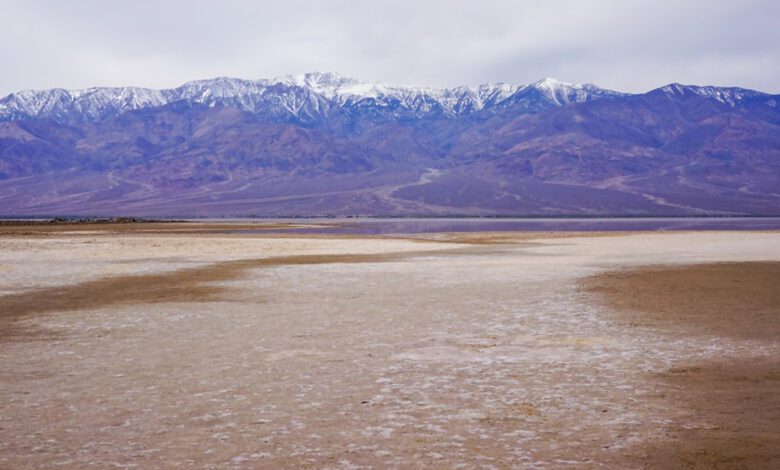
In the heart of the Mojave Desert, on the border of California and Nevada, an extraordinary natural spectacle has unfolded. Death Valley, famous for its extreme heat and arid climate, became the focus of attention this year due to unusual rainfall. In recent weeks, the area has received record amounts of rain, leading to an unexpected phenomenon: water has reappeared at the site of the long-dry Lake Manly.
Lake Manly, which once reached depths of over 300 meters, vanished more than 10,000 years ago at the end of the last Ice Age. Today, its waters once again cover part of the iconic Badwater Basin—the lowest point in North America. Although the lake is now only a few centimeters deep, the event has become a real sensation for locals and tourists alike.
Rainfall Records
The U.S. National Park Service recorded that the fall of 2025 was the wettest in Death Valley’s history. Over three months, the area received 6.12 centimeters of rain, nearly three times the annual average for the region. In November alone, there was 1.76 inches of rain, breaking the previous record.
For most places around the world, these numbers might seem modest, but for one of the driest spots on the planet, it’s a true anomaly. Typically, less than 5 centimeters of rain falls here in an entire year. As a result of this torrential downpour, water has once again spread across the ancient lakebed, even if it’s shallow.
Impact on Nature
The appearance of water in Badwater Basin has raised many questions among scientists and park staff. Above all, experts are discussing how these unusual weather conditions might affect the spring desert bloom. Rainfall can trigger the growth of wildflowers, but other factors are also needed—such as suitable temperatures and an absence of new droughts.
Forecasts remain cautious: park officials note that the true impact of the rains on Death Valley’s ecosystem will only become clear in spring. Meanwhile, many roads in the national park remain closed due to storm damage—mudflows and debris have made some areas impassable.
Historical context
Lake Manly is more than just a temporary puddle. During the Ice Ages, it stretched nearly 160 kilometers, fed by meltwater from the Sierra Nevada mountains. After the climate warmed and the glaciers retreated, the lake gradually disappeared, leaving behind only salt deposits and its memory in the geological record.
In recent decades, Lake Manly has reappeared several times—each time after heavy rains or hurricanes, as happened in 2023 following Hurricane Hilary. However, such extensive and sustained flooding has not been seen for many years.
Climate change
Meteorologists note that such unusual weather events are becoming increasingly common amid global warming. Rising global temperatures are leading to more frequent extreme precipitation, as well as sharper swings between drought and heavy rainfall. Death Valley is just one example of how even the most harsh and seemingly stable landscapes are undergoing dramatic changes.
Experts emphasize that such events serve as a reminder that nature can surprise us even in the most seemingly unchangeable places. Landscapes we tend to consider eternal are actually constantly transforming under the influence of time and climate.
In case you didn’t know, Death Valley is a U.S. national park located in southeastern California and partially in Nevada. It is home to the lowest point in North America—Badwater Basin, which lies 86 meters below sea level. Lake Manly, named after pioneer William Manly, was once one of the largest bodies of water in the region. Today, the park is visited by hundreds of thousands of tourists each year who come to see its unique landscapes, salt flats, and rare natural phenomena.