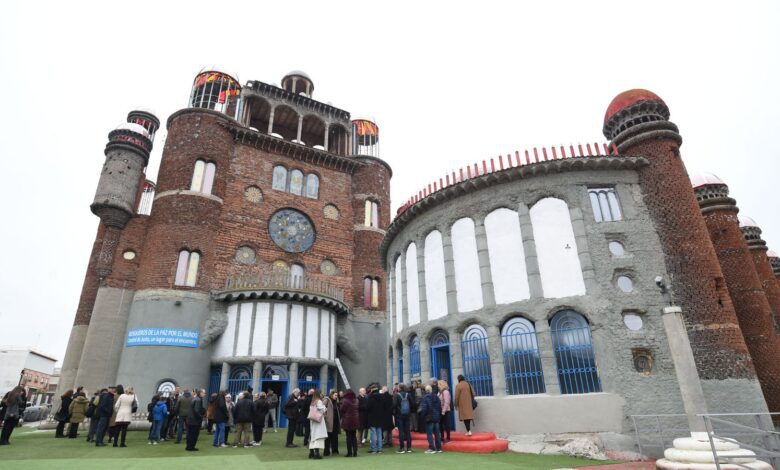
A conflict has erupted in Mejorada del Campo surrounding the famous Catedral de Justo. This building, long a symbol of human determination and creativity, has unexpectedly found itself at the center of an administrative dispute. The decision to suspend the site’s operations could impact hundreds of residents and tourists, as well as threaten social projects carried out within its walls.
The cathedral, built through the efforts of a single man—Justo Gallego—has become an integral part of the cityscape over the past six decades. Its walls are assembled from improvised materials: old tires, plastic barrels, leftover bricks, and cement. Despite lacking formal training, Justo managed to create an architectural landmark that drew attention not only from locals but also from the global media.
Administrative demands
In 2021, the building was transferred to the organization Mensajeros de la Paz, which continued to use it for charitable and cultural purposes. However, local authorities have recently demanded a halt to all activities at the cathedral due to the lack of an approved architectural plan. Officials insist on the submission of technical documentation certified by the Colegio Oficial de Arquitectos de Madrid.
Representatives of the organization claim that all the necessary documents were submitted several years ago. These include certificates of structural durability and the object’s legality. Nevertheless, city officials state that either the documents were not received or additional requirements were imposed by technical departments.
An unexpected turn
The situation escalated after the ARCO Foundation requested permission to hold a contemporary art exhibition within the Cathedral. During the approval process, it emerged that the building does not have a complete set of permits. This led to an official notice suspending the operation of the premises.
The College of Architects confirms that at the end of 2023, an official document legalizing the construction was issued. However, the reasons why the municipality is demanding these papers again remain unclear. Two scenarios are possible: either the documents did not reach the proper department, or new technical remarks have arisen.
Social role and uncertainty
The Cathedral has long been not only an architectural landmark but also an important social center. Food is regularly distributed here to families in need, along with guided tours and cultural events. After the building was handed over to ‘Mensajeros de la Paz,’ these functions only grew, along with the number of visitors.
The organization is currently trying to obtain a license to open and operate the site as a community center and exhibition hall. However, until all formalities are settled, access to the building remains restricted. This has raised concerns among local residents and charities, who fear for the future of social programs.
History and Challenges
The Cathedral of Justo has faced bureaucratic obstacles before. Even during its creator’s lifetime, the site lacked official permits, blueprints, and technical plans. Neither the municipality nor the church authorities wanted to take responsibility for a building constructed without adhering to safety standards.
Despite this, the cathedral has withstood extreme weather events, including the famous Filomena storm and heavy rains in recent years. Its unique story has attracted attention not only from Spaniards but also from the international community: in 2005, Justo’s work was showcased at the Museum of Modern Art in New York (MoMA).
It is still unclear when the site will reopen to visitors. Authorities and owners are waiting for documentation to be approved, while tourists continue to visit the unusual building, hoping to take photos with its dome in the background. The future of the Cathedral remains uncertain and its fate is a topic of discussion among locals.
In recent years, Spain has seen a rise in the temporary closures of historic and unusual sites due to documentation issues or new safety regulations. Similar cases have involved certain museums and private cultural centers in Madrid and Barcelona. Such conflicts often lead to lengthy negotiations between owners and authorities, with the fate of the buildings decided only after public outcry and intervention from specialized organizations.