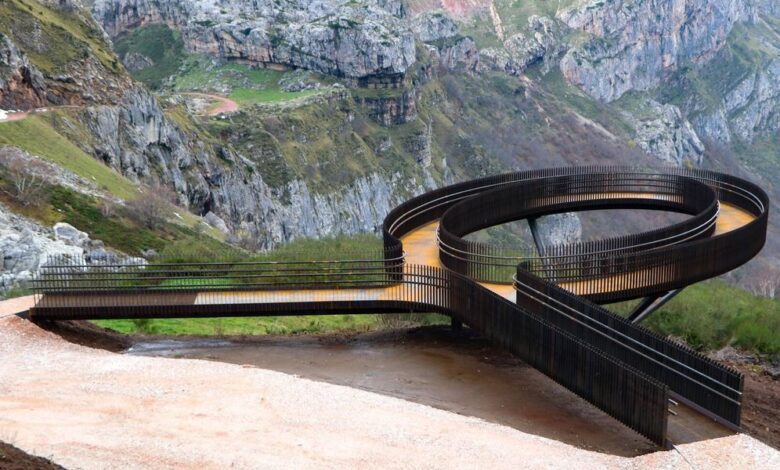
In the heart of the Somiedo Natural Park in Asturias, at an altitude of 1,700 meters, stands a structure that is rapidly redefining the relationship between architecture and the wild. The La Farrapona geological viewpoint is not simply a bridge or a balcony, but rather a suspended metal ribbon inviting visitors on a journey above the Saliencia valley. Its debut has become an international event, attracting the attention not only of tourists but also the film industry, whose representatives, after visiting last summer, expressed their admiration for the site.
The structure, designed by a Madrid-based architectural studio, is a closed loop that appears to float in midair. This effect is achieved by resting it on just four columns, grouped in the shape of an inverted pyramid, creating a sense of remarkable lightness and minimal intrusion on the landscape. A special type of steel—corten—was chosen for construction. This material not only withstands the harsh mountain climate, with freezing winters and nearly thirty-degree heat in the summer, but also develops a noble patina over time, blending seamlessly with the surrounding rocks. Its silhouette against the mountain peaks has already become one of Somiedo’s symbols. From the outset, the project was conceived as a fully accessible space, allowing absolutely everyone, including those with limited mobility, to enjoy the views.
However, the true magic of this place is revealed when the wind picks up. As air currents pass through the teardrop-shaped perforations in the surface, they create a long, ever-changing melody. This acoustic effect, originally a technical solution for draining water and melted snow, has turned the engineering structure into a kind of musical instrument, playing in harmony with nature. This very feature became its most recognizable hallmark, giving rise to the legend of the “singing” trail.
In addition to its aesthetic and acoustic appeal, walking along the platform offers an educational experience. Along the route, information panels highlight nine geological points of interest. Using QR codes prepared by experts from the University of Oviedo, visitors can access detailed information about rock formations, fossils, and traces of the area’s turbulent industrial past. From the platform, there is a view of the remains of the old Santa-Rita mine. Between 1956 and 1978, iron ore was actively extracted here, leaving scars on the mountainside: waste heaps, tunnel entrances, and a whole network of underground galleries reaching up to 12 levels.
The location itself, the Alto de la Farrapona pass, is a landmark at the border of Asturias and Castilla y León. It is a popular spot among hikers, cyclists, and anyone who appreciates untouched nature. The surrounding area is home to one of the symbols of the Cantabrian Mountains—the brown bear—which adds special significance to this region. A bit higher up the slope lies the Saliencia glacial lake system, including Lake Calabazosa, the deepest in Asturias, offering a breathtaking sight.
Reaching this marvel of engineering is fairly easy. The SD-1 road leads from the town of Pola de Somiedo, with the drive taking about half an hour. From a specially equipped parking lot, a trail leads to the main platform—a walk of no more than ten minutes. After completing this short path, visitors find themselves embracing a grand panorama that fully reveals the park’s magnificence and explains why this corner of Spain has captured the hearts of travelers from around the world.