In a cave near Casablanca, archaeologists have discovered bones that could overturn our understanding of where and how modern humans originated. The site, known as Grotte à Hominidés, yielded jaws, teeth, and vertebrae estimated to be around 773,000 years old. This period marks the early divergence of evolutionary lines leading to Homo sapiens, Neanderthals, and Denisovans. Remarkably, the bones are exceptionally well preserved, allowing scientists to conduct detailed analyses and gain new insights into our ancestors.
Research revealed that the remains belong to an African population situated at a crucial evolutionary crossroads. Their anatomical features combine traits typical of future humans and Neanderthals, along with more ancient characteristics inherited from early members of the Homo genus. This discovery reignites the debate over whether Africa was truly the sole cradle of modern humans.
Magnetic time markers
One of the most striking findings is the precise dating of the discovery. Ancient human bones are typically difficult to assign to a specific period, but at Grotte à Hominidés, the situation is different. The sediment layers containing the remains clearly record the last reversal of the Earth’s magnetic poles—the so-called Matuyama-Brunhes reversal. This event occurred about 773,000 years ago, leaving a unique geological signature in the rock. The bones were found within this layer, allowing scientists to confidently determine their age.
Such precise dating is extremely rare for archaeologists. Usually, they must rely on approximate estimates, but here several factors aligned: geology, archaeology, and paleomagnetic data all matched. This makes the discovery particularly valuable for science.
Transitional anatomy
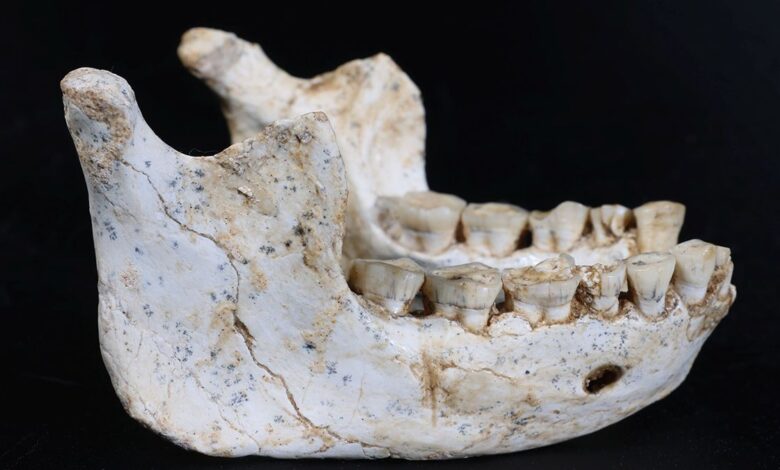
Two adult jaws and one child’s jaw were found in the cave, along with several teeth, vertebrae, and part of a femur. Despite the limited material, scientists were able to learn a lot. The jaws were long, low, and narrow, with a joint set far back—features not seen in either modern humans or Neanderthals, but more closely resembling Homo erectus. However, the teeth were smaller and closer in size to those of modern humans.
Using computed tomography, researchers studied the internal structure of the teeth—the connection between enamel and dentin. This area turned out to be different in shape from both Homo erectus and the European Homo antecessor, while still retaining some primitive traits. Neanderthal features are completely absent, indicating an independent evolutionary branch.
Lineage divergence
According to researchers, the geographic isolation of the Moroccan population and European Homo antecessor indicates they were separate groups. The inhabitants of Grotte à Omnivide likely represented the African stem lineage from which modern humans later emerged. Meanwhile, Homo antecessor was possibly a ‘sister’ population that took a different evolutionary path in Eurasia.
The mosaic of traits found in the Moroccan bones suggests a transitional period. These people were not the last common ancestors of Homo sapiens and Neanderthals, but lived very close to that point in time. Their anatomy offers a new perspective on the process by which evolutionary lineages separated, helping us understand how features typical of modern humans developed.
The African Origin
The study’s authors emphasize that their findings are consistent with genetic data, which also points to the deep African roots of Homo sapiens. Maghreb—a region in northwestern Africa where Casablanca is located—has become a key location for research into the origins of our species. This adds weight to the African, rather than Eurasian, theory of the emergence of modern humans.
Nevertheless, debate within the scientific community continues. Every new fragment of ancient bone can change our understanding of the past. And while the remains discovered do not provide a definitive answer, they bring us closer to solving one of humanity’s greatest mysteries.
If you didn’t know, Casablanca is Morocco’s largest city and a major center for archaeological research in North Africa. Unique ancient sites are regularly discovered in the surrounding area, enabling scientists to reconstruct the history of human settlement on the continent. The Grotte à l’Hominidé cave is considered one of the most promising sites for studying early stages of human evolution. In recent years, it has attracted international expeditions, bringing together experts from different countries and research traditions.