During archaeological excavations in Spain, researchers made a remarkable discovery that is reshaping our understanding of medieval warriors’ lives. In an ancient necropolis belonging to the powerful Order of Calatrava, archaeologists uncovered the remains of a person with an extremely unusual skull shape. This anomaly may point to a rare genetic disease, casting doubt on long-held assumptions about who could become a knight in those harsh times.
The excavation took place at the Sorita de los Canes castle, located in today’s province of Guadalajara. In the 12th and 13th centuries, this fortress served as a crucial stronghold for the Order of Calatrava in its fight against the Moors during the Reconquista. It was here, on sacred cemetery grounds, that warriors who gave their lives for faith and the crown were laid to rest.
Among the numerous graves—mostly those of adult men—one in particular drew the interest of researchers. It contained the remains of a man who was approximately 45-49 years old at the time of his death. Anthropological analysis revealed that his right arm was exceptionally well-developed, while the stress on his legs was moderate. These features, along with other signs, suggest a life spent on horseback. Without a doubt, this man was an experienced rider and warrior.
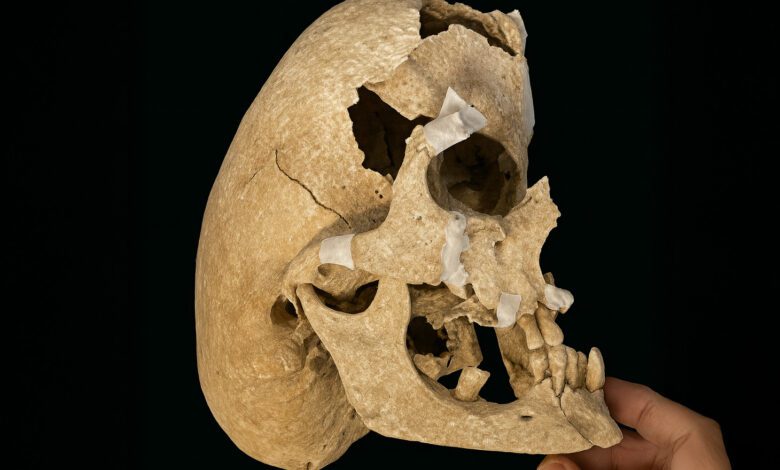
His remains showed clear signs of a violent struggle. Two blows with a cold weapon struck the head—in the temple and the back of the skull. Additionally, there was an injury on his left shin from a strong blow with a blunt object. These injuries were most likely the cause of his death, supporting the theory that he was a knight who fell in battle.
However, the most intriguing detail was the shape of his skull. Measurements revealed an extremely rare phenomenon—ultradolichocephaly. The width-to-length ratio of his skull was only 0.53, whereas in modern Spaniards, this figure averages 0.75. In other words, his skull was abnormally long and narrow.
According to scientists, this deformation was most likely caused by premature fusion of the cranial sutures in early childhood, a condition known as craniosynostosis. This condition is often a symptom of Crouzon syndrome—a rare congenital disorder. It can be accompanied by serious vision, hearing problems, and even intellectual disability.
The fact that a person with such a potentially severe condition not only survived but also became a member of an elite military order and lived to nearly 50 is remarkable. It suggests that his intellectual and physical abilities allowed him to lead a full life as a warrior, challenging our assumptions about medieval society and its attitude toward people with congenital conditions.
For reference, the Order of Calatrava was founded in 1158 in the Kingdom of Castile by Abbot Raymond of Fitero. It became the first military-religious order established in Spain. Its main mission was to defend territories reclaimed from the Moors, particularly the city of Calatrava la Vieja. The knights of the order played a key role in the Reconquista, becoming a symbol of Christian resistance and military valor on the Iberian Peninsula.