In 2025, the American company Blue Origin announced sweeping changes to its rocket program. The developers intend to create a new super-heavy rocket whose specifications will rival industry leaders. This move is a response to rapid advances by competitors and the growing demands of the space launch market.
Over the past decade, the industry has undergone a true revolution: private companies began using reusable rocket stages, which dramatically reduced launch costs. SpaceX was the first to successfully implement this technology, and now Blue Origin aims not only to match that success, but also to introduce its own innovations.
Technical shifts and new ambitions
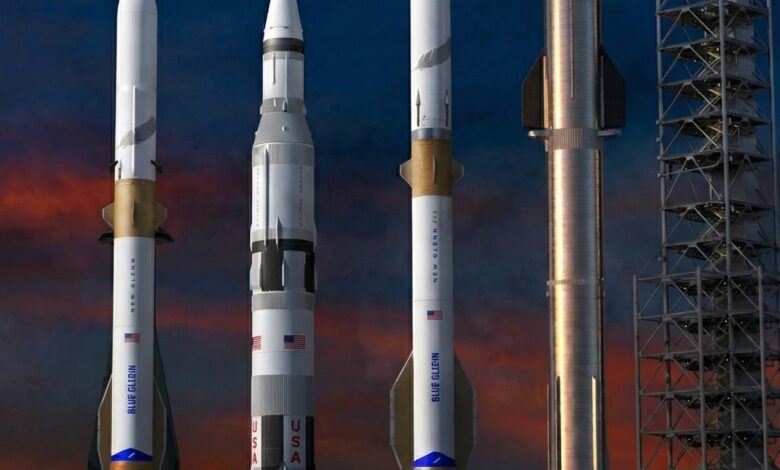
The current heavy-lift rocket, New Glenn, is capable of delivering up to 45 tons of payload to low Earth orbit. However, in the coming years, the company plans to increase this figure to 70 tons. To achieve this, Blue Origin’s engineers have redesigned the structure: the first stage will be equipped with nine hydrogen engines instead of seven, and the second stage will have four instead of two. The new configuration is designated 9×4, compared to the current 7×2.
Other parameters will also change. The payload fairing diameter will increase to 8.7 meters, allowing for the launch of larger satellites and modules. The thrust of the BE-4 engines will rise to 2.85 meganewtons, while the BE-3U engines of the second stage will be boosted by a quarter. Thanks to these upgrades, the rocket will be able to deliver more than 20 tons to lunar trajectories.
Strategy shift and new objectives
In recent years, Blue Origin has had to reassess its priorities. While the company was developing a reusable first stage, SpaceX had already moved on to testing the fully reusable Starship. To keep up, Blue Origin decided to focus on boosting the power and payload capacity of its launch vehicles.
The new rocket is tasked with launching large satellite constellations, supporting lunar missions, and fulfilling military contracts. Notably, there is discussion about using the rocket to launch the Orion spacecraft, which is currently only launched using the expensive and inefficient SLS.
Challenges and prospects
Despite its ambitious plans, experts note that meeting the announced timeline will be extremely difficult. Blue Origin was founded in 2000, but its first orbital launch only took place in 2025. Developing a super-heavy rocket based on an existing design in just two years would require significant resources and experience.
The company has undergone management changes: a manager from Amazon—unconnected to traditional aerospace corporations—has taken the helm. This could provide fresh momentum for development, but raises questions about the new leadership’s technical expertise. Unlike Elon Musk, who is personally involved in engineering decisions, Blue Origin’s new head has not yet shown the same hands-on approach.
Competition and the future of the market
It remains unclear whether Blue Origin will be able to deliver a fully reusable second stage, which is Starship’s key advantage. Without this, competing with SpaceX in the commercial market will be difficult. However, the company may focus on government contracts and military programs, where cost and efficiency requirements differ from those of the commercial sector.
In the coming years, the space launch market is set for a new wave of competition among private giants. Blue Origin’s success in developing a super-heavy rocket could shift the balance of power and open new opportunities for lunar exploration and deep space missions.