The arrival of the BYD Atto 2 DM-i on the Spanish market instantly changes the game for anyone who still believed in the monopoly of European brands over hybrid technology. This new compact SUV doesn’t just expand the Chinese manufacturer’s lineup—it calls into question the feasibility of buying many competitors, offering up to 1,000 kilometers of range and a starting price that makes even the most devoted petrol fans nervously recalculate their savings. As fuel and electricity costs continue to rise and government subsidies grow ever more elusive, this move looks not only bold, but downright provocative.
Having already established itself in the market with the Seal U DM-i and Seal 6 DM-i models, BYD is now targeting the mainstream buyer. The Atto 2 DM-i is not just another toy for tech enthusiasts to show off—it’s a practical tool for real savings and efficiency. Still, the brand’s signature Asian flair is present: the design, features, and technical solutions are clearly intended to make European consumers feel just a bit out of their comfort zone.
Design details
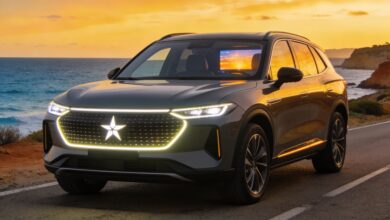
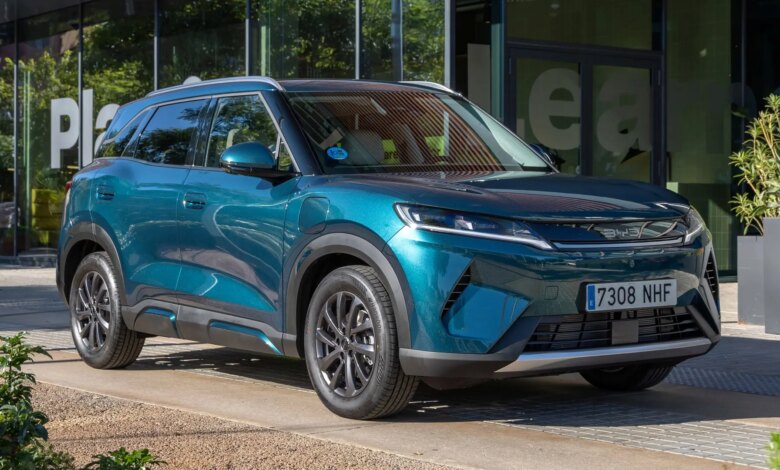
The Atto 2 DM-i dimensions (4.33 m long, 1.83 m wide, and 1.675 m high) put it in direct competition with familiar city crossovers, while the cabin is notably spacious. Inside, you’ll find roominess, a practical central console, and a 425-liter trunk that expands to 1,335 liters with the seats folded. The exterior stands out: LED headlights, a bold radiator grille, aggressive lines, and the brand’s signature light strip linking the figure-eight taillights. The Chinese have clearly decided that modesty is for the losers.
The interior features an 8.8-inch digital instrument panel and a 12.8-inch multimedia screen running the latest proprietary software. The natural language assistant ‘Hi BYD’ and Google integration are aimed at showing that Chinese cars have caught up in technology. However, for those used to German austerity, the abundance of gloss and bright accents may seem excessive — but that comes down to personal taste.
Technology and range
The main highlight of the Atto 2 DM-i is its Dual Mode Intelligent hybrid system, which combines an electric motor with a 1.5-liter Xiaoyun gasoline engine offering 43% thermal efficiency. The vehicle can run purely on electric power or in hybrid mode, where the gasoline engine recharges the battery while driving. When needed, both engines work together, delivering performance worthy of much more expensive models.
Depending on the configuration, the Atto 2 DM-i offers two options: Active, with a 7.8 kWh battery (166 hp, 40 km electric range, 930 km total range), and Boost, with an 18 kWh battery (212 hp, 90 km on electricity, up to 1000 km combined cycle). Acceleration to 100 km/h takes 7.5 seconds, and the top speed is 180 km/h. For an urban crossover, these figures are not just respectable—they’re outright provocative compared to rivals charging twice as much for similar specs.
Equipment and Safety
Even the base Active version isn’t lacking: alloy wheels, LED headlights, parking sensors, rearview camera, adaptive cruise control, and keyless entry via smartphone or bracelet. The Boost adds a panoramic roof, heated and power front seats, 17-inch wheels, 360-degree camera, heated steering wheel, 50 W wireless charging, tinted windows, and a V2L function for powering external devices.
Safety systems include automatic emergency braking, intelligent cruise control, lane keeping, blind spot monitoring, traffic sign recognition, and driver fatigue detection. In short, if anyone still thinks Chinese cars are just cheap and basic, it’s time to rethink. Here, savings don’t come at the expense of safety or comfort.
Prices and Market Reality
In Spain, the Atto 2 DM-i Active starts at €28,200, but with all promotions and the new Auto+ plan, the price drops to €20,940. The Boost version starts at €31,200, and with the maximum discounts — €24,940. In a market where this amount usually gets you dull plastic and engines from a bygone era, such pricing is a direct challenge to the entire Old World auto industry. Of course, there’s a catch: to get the lowest price, you’ll need to take out a loan and agree to conditions that bankers clearly didn’t craft for ordinary people.
Even so, even without the discounts, the Atto 2 DM-i remains one of the most affordable hybrids with similar specifications. And if European manufacturers don’t urgently reconsider their price tags, Chinese brands will soon push them out of the market entirely. Still, for those who believe in miracles, there’s always hope for another ‘revolution’ from local brands. But for now, the reality is this: BYD sets the rules, and everyone else has to play catch-up.
BYD is a Chinese automotive giant that has, in recent years, evolved from a local player into a global leader in the production of electric and hybrid vehicles. The company actively invests in its own technologies, develops unique batteries and powertrains, and builds factories around the world. In Europe, BYD is viewed with caution, but its successes can no longer be ignored: each new model launch is an event capable of shifting the balance of power in the market. In Spain, the brand focuses on affordability and advanced technology, while also prioritizing safety and comfort—especially important for local buyers accustomed to high standards.