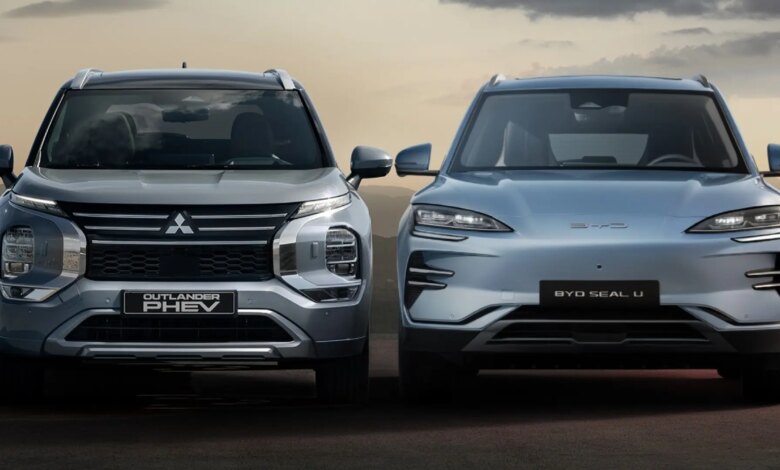
The hybrid SUV market in Spain is booming, with drivers increasingly opting for plug-in vehicles. Two models have taken center stage, each setting segment standards in its own way. The Chinese BYD Seal U DM-i is rapidly gaining popularity, while the Japanese Mitsubishi Outlander maintains its standing thanks to its reputation and technical solutions. Comparing these vehicles not only highlights differences in hybrid technology approaches but also underscores how buyer preferences are evolving in 2026.
Both crossovers feature advanced hybrid systems, but their philosophies and equipment differ significantly. One emphasizes technology and accessibility, while the other focuses on proven quality and comfort. This article offers a detailed analysis of key characteristics, trim features, and user experience nuances that could be decisive when choosing between the two models.
Dimensions and design
The BYD Seal U DM-i stands out for its impressive size: 4.75 meters long, 1.89 meters wide, 1.67 meters high, and a wheelbase of 2.76 meters. The exterior is understated yet fresh, avoiding flamboyance but drawing attention thanks to its novelty. Inside, the spaciousness is pleasantly surprising even for seasoned drivers: there is more legroom and width than most competitors, and cabin height leaves nothing to be desired.
However, the BYD Seal U DM-i’s trunk is not class-leading: its capacity ranges from 425 to 450 liters depending on the version, and with the rear seats folded, it reaches 1,445–1,460 liters. Here, the advantage shifts to the Mitsubishi Outlander, which offers a larger cargo area.
The fourth-generation Japanese crossover is slightly shorter (4.72 meters), but taller (1.75 meters) and wider (1.86 meters), with a wheelbase of 2.70 meters. The Outlander’s exterior inspires confidence with its robust lines and off-road styling. Inside, it features comfortable rear seats with adjustable backrest tilt, separate climate control and heating, as well as window blinds. The trunk here is noticeably more spacious — 495 liters, and with the seats folded down — 1,404 liters.
Technology and Features
The BYD Seal U DM-i comes equipped with two digital screens: a central multimedia display (12.8 or 15.6 inches) with a rotating function, wireless Apple CarPlay and Android Auto support, as well as voice control. The second screen (12.3 inches) is for the instrument panel, though its interface is not always intuitive. The interior uses modern materials, and configurations include 19-inch wheels, a panoramic sunroof, powered trunk, LED headlights, surround-view cameras, plus heated and ventilated front seats.
The top Design version adds wireless charging, a head-up display, and an advanced audio system with ten speakers. All BYD Seal U DM-i models feature V2L capability—allowing energy to be supplied to external devices, a function increasingly in demand among modern drivers.
The Mitsubishi Outlander, on the other hand, focuses on ergonomics and classic solutions. Two 12.3-inch screens—one for instruments, one for multimedia—are complemented by physical buttons and a convenient knob for quick access to key functions. Climate control is also managed by dedicated keys. Standard equipment includes 18-inch wheels, fabric upholstery, and four exterior cameras. Higher trims offer 20-inch wheels, a leather interior, adaptive headlights, a head-up display, a power tailgate, heated steering wheel and seats, as well as a premium Yamaha Ultimate audio system with 12 speakers and massage function for the front seats.
Engines and Batteries
The BYD Seal U DM-i is offered in three versions: two with a combined output of 218 hp (a 1.5-liter gasoline engine and an electric motor), and a top version with 324 hp and two electric motors. Battery options include 18.3 kWh (up to 80 km electric-only) and 26.6 kWh (up to 125 km on electricity alone). All versions support fast charging with alternating current (up to 11 kW) and direct current (up to 18 kW) and feature lithium iron phosphate batteries known for their durability and safety.
The Mitsubishi Outlander is available with a single powertrain: a naturally aspirated 2.4-liter gasoline engine paired with two electric motors (one on each axle) for a total of 306 hp. The 22.7 kWh battery provides an electric range of up to 86 km. Charging is possible with both alternating current (up to 3.6 kW) and direct current, but it uses the CHAdeMO connector, which is less common in Spain than the European CCS2 standard.
Prices and Cost-effectiveness
The Chinese crossover starts at €38,500, but with current discounts it can be purchased for €35,790. Even the most advanced Comfort version with a 125 km battery costs €38,790. The Mitsubishi Outlander is noticeably more expensive: the base model will cost at least €50,800, or €48,300 with a discount. The price difference between similarly equipped versions reaches almost €10,000, which for many buyers becomes a decisive factor.
At the same time, the BYD Seal U DM-i offers a wider range of trims and battery options, as well as modern features rarely found in rivals. The Outlander stands out for its reliability, more powerful petrol engine, and roomy trunk. But it’s hard to ignore the price gap, especially amid growing competition among hybrid SUVs.
Trends and prospects
In recent years, Chinese manufacturers have been actively promoting hybrid technologies to bypass new EU tariffs introduced in 2024. This allows them to offer cars with an attractive balance of price and features. The BYD Seal U DM-i is a prime example of this approach: its affordable price, extensive features, and high electric range make it one of the most compelling options on the market.
The Japanese Mitsubishi Outlander, despite its higher price, remains popular thanks to its solid reputation, build quality, and well-thought-out ergonomics. Its 2.4-liter engine and classic control approach appeal to those who value proven solutions and are not willing to compromise on reliability.
In case you didn’t know, BYD (Build Your Dreams) is one of China’s largest automakers, specializing in electric vehicles and hybrid technology. The company is actively expanding its presence in Europe, offering a wide range of models and innovative battery solutions. Mitsubishi Outlander is the flagship SUV of the Japanese brand Mitsubishi Motors, known for its hybrid versions and high level of comfort. The fourth generation of the model was introduced in Spain in 2024 and quickly gained popularity among family car enthusiasts.