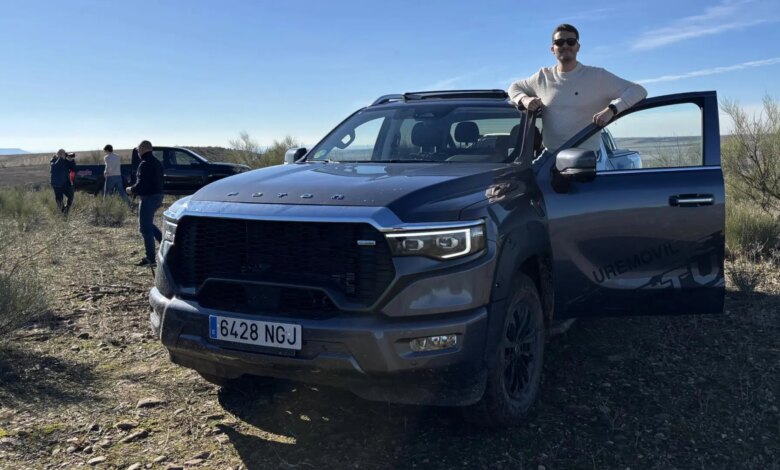
Chinese automotive giant Foton has surprised many by entering the European market with the Tunland V9—a large pickup that, at first glance, could easily be mistaken for an American legend. The vehicle’s exterior evokes associations with iconic US models, while its size and aggressive grille make it clear: this newcomer has no intention of staying in the shadows.
In 2025, Foton officially launched sales in Spain, offering two pickups right away: the utilitarian G7 and the more premium V9. Although total sales remain modest for now—250 vehicles in a year—the company is confident demand will grow. In the coming years, the country’s pickup market is expected to expand, and Foton aims to secure a significant share.
Design and features
The appearance of the Tunland V9 leaves no one indifferent: stretching nearly 5.62 meters, with bold shapes and details reminiscent of the Dodge Ram and Ford F-150. Inside, the approach is entirely different from the workhorse G7. Here, the focus is on comfort and modern technology. The cabin is trimmed with synthetic leather, and several controls are borrowed from Mercedes-Benz thanks to a partnership with the German company.
The driver is greeted by electrically adjustable heated and ventilated front seats, dual-zone climate control, and a panoramic roof. A 12.6-inch digital instrument panel and a 14.6-inch multimedia touchscreen with Apple CarPlay and CarBit support emphasize the model’s technological edge. Despite some shortcomings in the plastic elements, the overall interior impression is above average for the segment.
Technical specifications
The main technical feature of the Tunland V9 is its diesel engine paired with a 48-volt mild hybrid system, allowing it to obtain the prestigious ECO environmental label. The engine delivers 162 hp and 450 Nm of torque, working in tandem with an eight-speed automatic transmission and all-wheel drive. This setup ensures confident performance both on asphalt and off-road.
The pickup can carry up to 895 kg of cargo, and its 24 cm ground clearance along with impressive approach and departure angles (28 and 26 degrees respectively) make it suitable for challenging routes. It is equipped with a low-range gearbox, rear differential lock, and the ability to ford water up to 70 cm deep. All this positions the Tunland V9 as a serious contender in the off-road vehicle market.
Off-road
Tests on rough terrain showed that the Tunland V9 confidently handles dirt roads, mud, and bumps. Standard Giti4x4 AT71 tires provide decent traction, although more aggressive tires may be needed in particularly tough conditions. The engine’s power is enough to tackle climbs, while the low-range gearbox helps to get out of tricky situations.
The automatic transmission sometimes responds with a delay, keeping the revs higher than expected, but overall does not hinder steady progress. The suspension effectively absorbs impacts, and the light steering makes it easier to maneuver on uneven ground. Inside, the cabin remains quiet and comfortable, even on rough roads.
Positioning and outlook
The Foton Tunland V9 makes no secret of its ambitions: this model aims to compete with top versions of the Ford Ranger and Toyota Hilux. Priced from €54,900 (or €49,125 with promotions and financing), the pickup offers rich equipment and an impressive array of off-road features. In 2027, a PHEV hybrid version with 475 hp and an electric range of over 120 km is expected, a move set to further strengthen the brand’s position in the market.
Foton plans to expand its lineup and introduce new technologies to attract not only professionals but also private buyers looking for a versatile vehicle for both work and leisure. In the coming years, competition in the pickup segment in Spain is expected to become especially intense.
Foton is one of the largest Chinese manufacturers of commercial vehicles, founded in 1996 and part of the BAIC Group. The company specializes in trucks, buses, and pickups and is actively developing its export operations. In recent years, Foton has focused on eco-friendly technologies and partnerships with global automakers, enabling it to quickly adapt to the demands of the European market. The Tunland V9 model has become a symbol of the brand’s new development stage, combining distinctive design, modern technologies, and ambitions to reach leading positions beyond China.