Winter evenings in the northern United States turn the sky into the stage for a cosmic spectacle. The crisp air makes the stars shine with exceptional brightness, and the clarity of the atmosphere reveals even the most distant celestial objects. However, to ensure stargazing remains a pleasure rather than a test of endurance, choosing the right clothing is essential. Seasoned astronomers recommend lightweight yet warm jackets with hoods, along with insulated pants and waterproof footwear. Special attention should be paid to your feet: two pairs of socks and roomy boots will keep out the cold, even on the frostiest nights. For those planning to spend several hours under the stars, insulated boots are indispensable.
Once dusk gives way to deep darkness—about an hour and a half after sunset—the true gems of the winter sky begin to emerge. This is when five of the season’s most striking sights become visible, ready to be admired with the naked eye, binoculars, or a small telescope. Each of them is sure to surprise even the most experienced observers.
Star Clusters
In January and February, the eastern sky is adorned by the constellation Gemini, where Jupiter stands out this season like a silver spark among the stars. If you trace a line from Alhena to the more modest Tejat and Propus, just above and to the right of the latter you’ll find Messier 35 (M35). On a clear night, this open star cluster is barely visible to the naked eye, but even basic binoculars turn it into a cloud of hundreds of tiny lights. Through a telescope, M35 is truly spectacular: it spans a patch of sky as large as the Moon and dazzles with its curved chains of stars. It’s no surprise this is considered one of the winter sky’s most beautiful objects.
To the northwest, hidden among the zigzag of Cassiopeia’s five bright stars, lies another wonder — the Double Cluster in Perseus. Draw an imaginary line from Gamma Cassiopeiae through Delta Cassiopeiae, and you’ll come across a faint patch. Binoculars reveal its secret at once: these are two open clusters — NGC 869 and NGC 884 — that together create one of the most striking sights of winter. Both clusters span an area larger than the Moon, so low magnification works best for viewing. At the center of one, an unusually red star adds a dramatic touch to the scene.
The Bulls and Their Sisters
High in the southern sky shines the constellation Taurus, home to two renowned star clusters—the Hyades and the Pleiades. The Hyades are the closest major cluster to Earth, their stars forming a recognizable V-shape crowned by the bright orange Aldebaran. However, this giant star is actually much nearer to us than the rest of the cluster and only appears aligned with them by coincidence. In contrast, the Pleiades are 440 light years away and look like a miniature dipper. For many beginners, the cluster is a puzzle: at first glance, it resembles a hazy patch, but careful observation reveals six or seven bright stars, and even more under ideal conditions. Through binoculars or a small telescope, the Pleiades sparkle like a handful of icy diamonds on a velvet background. Recent studies have shown that they are not just the ‘Seven Sisters,’ but a stellar city of over three thousand suns.
Both clusters belong to what are known as galactic clusters, which are concentrated along the plane of the Milky Way. In winter, observers look directly into the spiral arms of our galaxy, where many bright stars and clusters gather. This makes January and February nights particularly rich for discoveries.
Orion Nebula
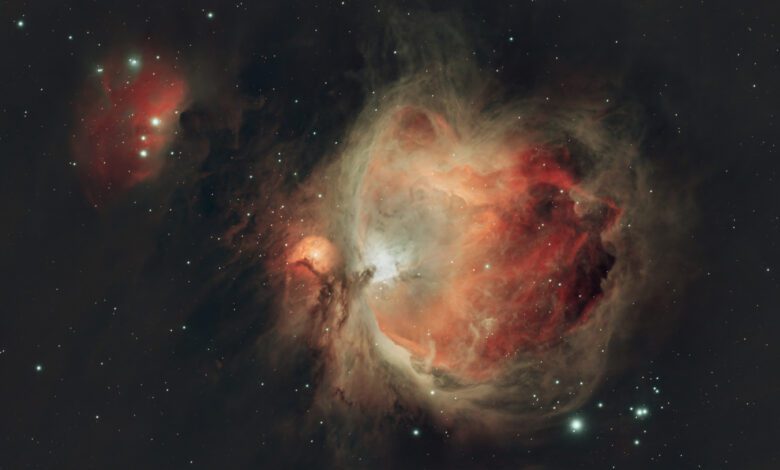
When Orion rises high in the southeast, it’s time for one of winter’s most spectacular celestial sights — the Orion Nebula (Messier 42). This vast cloud envelops the middle star in Orion’s “sword” and appears as a faint fuzzy patch even through binoculars. Through a telescope, a whole new world emerges: a giant glowing cloud of gas, spreading out like a fan or even resembling a ghostly bat. Hidden inside is a group of hot young stars — the Trapezium — whose ultraviolet radiation makes the gas glow. Astronomers believe this is where new stars are being born right now, and you can watch the process unfold before your eyes. The Orion Nebula is truly colossal: it measures 30 light-years across and lies about 1,500 light-years from Earth.
The experience of observing the Orion Nebula is hard to put into words. Even seasoned astronomers admit that each viewing feels like the very first. It’s not just another item to check off your list — it’s a real window into the stellar forge of the universe.
Tips for Observers
For those just starting their deep-sky journey, it’s important not only to pick the right time and place, but also to prepare your equipment. Binoculars with 7x magnification or a small wide-field telescope will let you see most of these objects in detail. Don’t forget about cameras: modern astrophotography gear can capture even the faintest nebulae and clusters. Winter nights are perfect for your first experiments in night sky photography.
Winter weather is full of surprises, so it’s best to check the forecast in advance and pick the clearest night possible. Even a brief outing into nature can offer unforgettable experiences and new insights about the Universe. Just don’t forget warm clothes and a thermos of hot tea.
If you didn’t know, Joe Rao is a renowned astronomer and educator who regularly gives lectures at the Hayden Planetarium in New York. His articles on space are published in leading scientific journals, and both beginners and experts value his advice on skywatching. Thanks to his recommendations, thousands of people have discovered the fascinating world of astronomy and learned to see much more than just stars in the night sky.