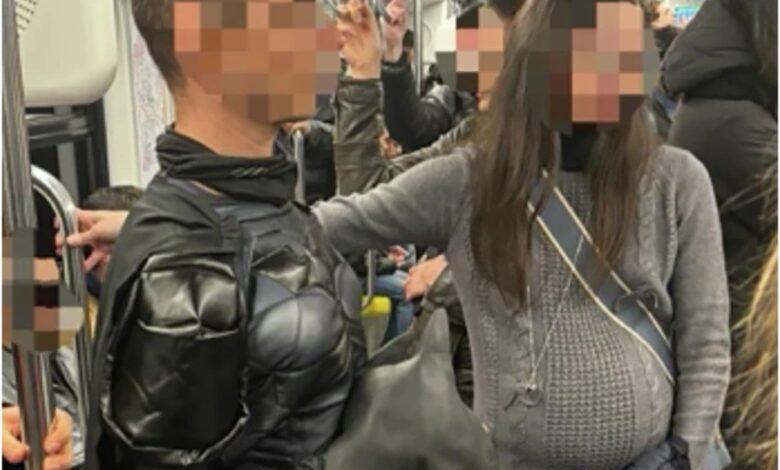
An unusual experiment was conducted in the Italian metro to find out how unexpected events influence people’s behavior in public spaces. Researchers from the Università Cattolica del Sacro Cuore in Milan decided to test whether more people would offer a seat to a pregnant woman if a well-known superhero appeared in the train car. To ensure a fair experiment, scientists divided their observations into two groups: in one, the woman posing as pregnant entered the carriage alone; in the other, she was accompanied by a passenger dressed as Batman.
During 138 train rides, the researchers recorded the reactions of the surrounding passengers. They found that Batman’s presence significantly increased the number of people offering a seat to the woman. While under normal circumstances people gave up their seats about a third of the time, with the superhero present this doubled. Interestingly, many passengers didn’t even realize their gesture might have been influenced by the unusual neighbor.
How surprise affects passenger behavior
Scientists note that unexpected events can disrupt routine and make people more attentive to those around them. In the experiment with Batman, 67% of passengers gave up their seat to a pregnant woman, whereas without Batman, only 38% did so. Interestingly, nearly half of those who showed kindness claimed they hadn’t noticed the person in the superhero costume. This suggests that unusual circumstances can influence behavior even on a subconscious level.
Another detail: it was most often women who gave up their seats. Researchers believe that such experiments help us understand how to foster goodwill and mutual assistance in urban environments. Perhaps introducing unexpected but safe events into daily life can make public transport more welcoming.
Psychology and Social Experiments: What Else Do We Know?
A similar effect has been observed in other studies. For example, in 2016, American scientists found that children who pretended to be Batman showed greater persistence in repetitive tasks. Taking on the role of a superhero helped them persevere and finish what they started. This confirms that unusual stimuli and playful elements can positively impact behavior—not only in adults, but in children as well.
However, the Batman example doesn’t always yield positive results. In Jordan, a curious incident occurred: a man became so absorbed in the role that he constantly wore the costume at home, restricted his wife’s TV viewing, and even snuck out at night on ‘secret missions.’ As a result, their marriage lasted less than a month. This case illustrates that excessive immersion in a role can lead to unexpected consequences.
Urban environments and prosocial behavior
The results of the Milan experiment could be valuable for urban planners and public space experts. If even the simple appearance of an unusual character can boost mutual assistance, it’s worth considering how to integrate such elements into city life. This approach isn’t just about entertainment, but could be an effective way to make public transport and other spaces more comfortable for everyone.
Researchers emphasize the importance of balancing surprise with safety. Not every unusual event is received positively, but well-organized initiatives can transform the atmosphere in transport and increase trust among passengers.
By the way: who is Batman, and why is his image so popular?
Batman is one of the most recognizable superheroes in global pop culture. The character first appeared in DC Comics in 1939. His real name is Bruce Wayne, a billionaire and philanthropist who, after the tragic death of his parents, dedicated his life to fighting crime in the fictional city of Gotham. Unlike many other heroes, Batman has no supernatural powers and relies on his intellect, physical training, and advanced technology.
Batman has been adapted for the screen many times, with films and animated series about him earning impressive box office returns worldwide. His symbol—a black bat—has become a true icon, and the phrase “I am Batman” has entered popular culture. Psychologists note that the hero’s popularity stems from his humanity and inner struggle, making him relatable to many. It’s no wonder that even seeing someone dressed as Batman in a regular subway car can change people’s behavior and remind them of the importance of helping one another.