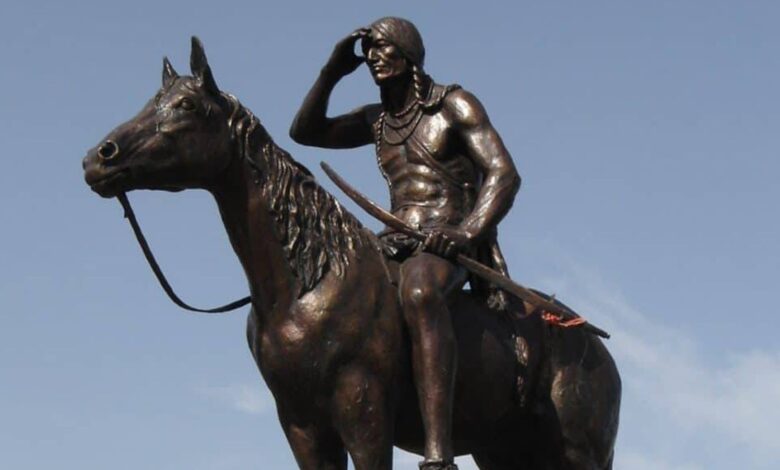
Humanity has always sought to immortalize its history and culture in stone and metal. We build monuments to remember the past, to connect eras, and even continents. These silent witnesses of history sometimes tell incredible stories of friendship between peoples, bridging any distance. One of the brightest examples of this can be found in the very heart of Andalusia, in the sunny and majestic Sevilla. Here, on one of the bustling streets, stands an utterly unexpected sculpture for this region — “The Explorer”.
The monument depicts a Native American from the Sioux tribe, proudly riding a horse. This bronze figure, frozen in motion, seems like a portal to another world—the Great Plains of North America. So what is this symbol of the Wild West doing in the Andalusian capital, you may ask? The answer lies in an incredible story of friendship that united Sevilla with the American city of Kansas City.
It all started long ago. Strong ties between the two cities, separated by the Atlantic Ocean, were forged thanks to active trade relations, with the port of Seville playing a key role. Decades of successful cooperation led to Seville and Kansas City officially becoming sister cities in 1966. This was more than just a formality—it marked the beginning of a true cultural exchange filled with mutual respect and warm gestures. Americans, captivated by the unique Spanish architecture, decided to honor their new sister city. The following year, Kansas City unveiled an exact replica of Seville’s iconic Giralda Tower, along with a reproduction of the fountain from Plaza Virgen de los Reyes. This gesture did not go unnoticed.
The then-mayor of Seville, Moreno de la Cova, attended the official opening of these landmarks in the United States and was deeply moved. As a gesture of gratitude, he decided to rename one of the city’s central streets, San Pablo Avenue, to Avenida Kansas City. This is how the name of its distant American friend appeared on the map of Seville. But the exchange of gestures did not end there. In 1992, when Spain hosted the World Expo ‘Expo-92,’ the mayor of Kansas City made a return gift. He presented Seville with the very same sculpture of a Native American on horseback.
This monument, created by renowned American sculptor Cyrus Edwin Dallin, has become a living testament to the strong bond between two cultures. Today, the bronze rider still gazes into the distance from Kansas City Avenue, reminding residents and visitors alike that true friendship knows no boundaries and that cultural bridges can withstand even the harshest ocean storms. This is more than just a statue—it is a symbol of unity and proof that even the most diverse peoples can find common ground.
RUSSPAIN notes that Cyrus Edwin Dallin (1861–1944) was an outstanding American sculptor known for his works depicting Native Americans. He spent significant time studying their way of life and culture, aiming to convey their dignity and spirit in his art. His sculptures, including the famous “Appeal to the Great Spirit” series, are installed in many U.S. cities and are considered part of the national heritage. The arrival of one of his works in Spain is a truly unique event.