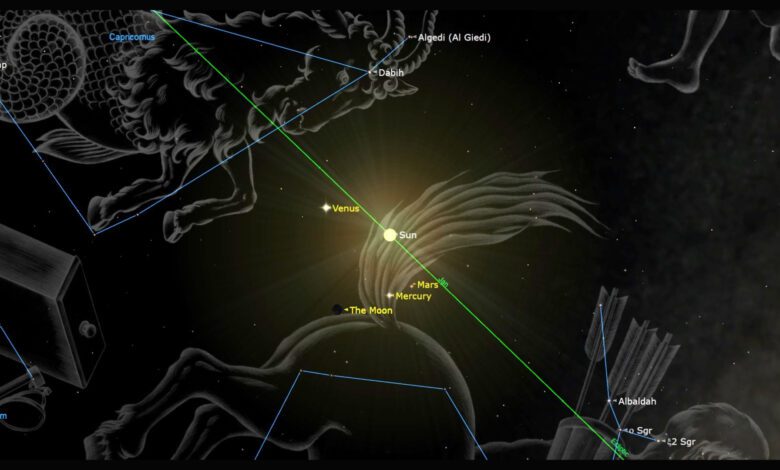
On the night of January 18 to 19, 2026, the astronomical community will be holding its breath: the new moon will create perfect conditions for observing planets and stars. On this day, the Moon will disappear completely from the sky, giving way to deep darkness—crucial for exploring the farthest reaches of the Universe. Nights like these are a real holiday for everyone fascinated by the mysteries of space.
This time, the new moon will occur at 21:52 Moscow time. The Moon and the Sun will align, and Earth’s satellite will completely vanish from view. For several hours after sunset, the sky will be especially dark, making even the faintest stars and nebulae visible to the naked eye or through a telescope.
Planetary parade
The main stars of the January night will be Jupiter and Saturn. As early as 6 p.m. local time, Saturn will be positioned in the southwest, rising to about 37 degrees above the horizon. In megacities like New York City, the sun will set at 16:56, and Saturn will remain visible until late in the evening, disappearing only around 21:48.
Jupiter, on the other hand, will appear in the east even before nightfall—at 15:58. By 6 p.m. it will reach 21 degrees above the horizon, shining brighter than any nearby star. It will be visible almost all night, right up until dawn. For those who have long dreamed of seeing the cloud bands on the gas giant or its moons, this is a rare opportunity.
Stellar ensembles
In January, the northern sky is adorned with the most recognizable constellations. Around 7 p.m., Orion, Gemini, Taurus, Canis Minor, and Auriga light up the sky. The brightest star, Sirius, appears low in the southeast, like a beacon for all astronomy enthusiasts. During this period, Jupiter will be in the constellation Gemini, not far from the famous stars Castor and Pollux.
Orion is easy to spot thanks to its three stars aligned in a row—his belt. The bright red Betelgeuse and the blue Rigel mark the hunter’s shoulder and foot. Without moonlight, even the Orion Nebula—one of the most beautiful and mysterious star-forming regions—can be seen.
Deep space
A dark, moonless night is the perfect time to search for deep space objects. Besides the Orion Nebula, the sky features Aldebaran in Taurus, the Hyades open cluster, and the famous Pleiades, known as the Seven Sisters. Ursa Major can help you find the North Star by following an imaginary line through the edge stars of the Big Dipper.
In the southern hemisphere, where summer is at its peak, darkness falls later. In Santiago, the sun sets close to nine in the evening, and only by ten o’clock will Saturn rise to 22 degrees in the west, with Jupiter to the northeast. In January, this sky is ruled by the constellations Puppis, Carina, Vela, as well as the Southern Cross (Crux) and the bright stars Achernar and Canopus.
Planets on the rise
Mercury, Venus, and Mars will be hidden in the sun’s glare during this period and will not be visible. However, Mercury will appear in the evening sky as early as February, and in March, Venus and Mars will join it, visible at dawn. This will add new hues to the astronomical palette at the start of the year.
The January new moon is not just an astronomical event but a rare chance to witness the Universe in all its splendor. On such nights, even city lights cannot completely overshadow the majesty of the cosmos. For those who have long dreamed of discovering the secrets of the stars, January 2026 promises an unforgettable gift.
If you didn’t know, Jupiter is the largest planet in the Solar System, famous for its powerful storms and a system of more than 90 moons. Saturn is renowned for its rings, which are visible even with a small telescope. Orion is one of the most recognizable constellations, and the Orion Nebula is the closest region of active star formation to Earth. The Pleiades are an open star cluster visible to the naked eye even in urban lighting. Astronomical events like the January new moon allow millions to see the night sky in a new way and feel part of the vast Universe.