In southern Italy, at the Grotta del Romito cave, archaeologists have uncovered unusual evidence of Cro-Magnon life from the Late Paleolithic era. After examining nearly three hundred bird bones, Italian researchers concluded that ancient humans did not limit themselves to hunting typical game. They were interested in large birds of prey, such as the golden eagle (Aquila chrysaetos) and the griffon vulture (Gyps fulvus). The reason for this interest turned out to be less obvious than one might expect.
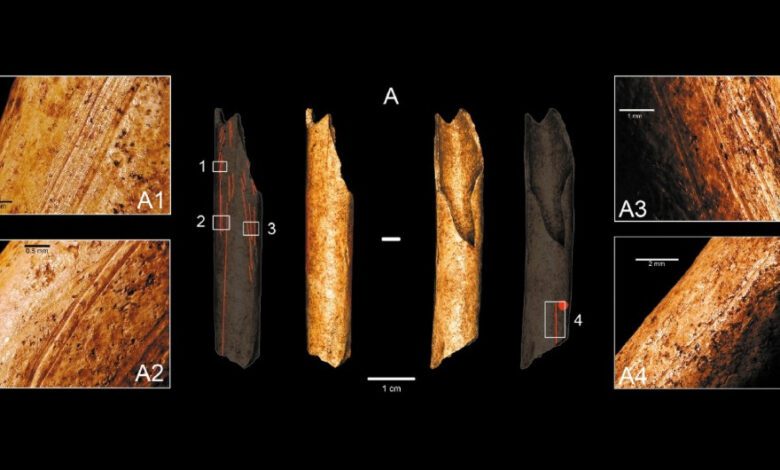
A careful analysis of the bones revealed traces of processing on some of them that were not related to butchering for meat. This was especially noticeable on the remains of golden eagles and vultures—cuts were found in areas with virtually no edible tissue. This led scientists to believe that Cro-Magnons hunted these birds for their feathers. The feathers could have been used for decoration, or possibly to make various household items.
Birds and humans
In recent years, archaeologists have increasingly focused on how ancient humans interacted with birds. It turns out that not only Homo sapiens, but also Neanderthals (Homo neanderthalensis) hunted birds. Moreover, they did so not only for food. Finds from across Europe suggest that the feathers and talons of birds of prey were used as material for decorations and amulets. For example, in Krapina, pendants made from talons have been discovered, while in other locations, ornaments made from feathers have been found.
Bird bones were also put to use. They were crafted into hunting calls, handles, needle cases, tubes, and even musical instruments. At Grotta del Romito, archaeologists found bones not only from birds of prey, but also from Eurasian jay (Garrulus glandarius), grey partridge (Perdix perdix), tawny owl (Strix aluco), and corncrake (Crex crex). Most of these remains ended up in the cave due to human activity rather than natural causes.
Traces on the bones
Of particular interest were 13 bones that showed clear evidence of human modification. Damage was found on remains of the long-eared owl (Asio otus), tawny owl, golden eagle, and griffon vulture. Researchers note that the placement of cut marks on the bones of birds of prey indicates feathers were being removed, rather than just butchering the carcass for food. This supports the hypothesis that feathers had both symbolic and practical importance for the Cro-Magnons.
Feathers could have been used to decorate clothing, headdresses, or hairstyles. Besides that, they may well have served as material for making arrows and other daily necessities. It is also possible that the bones of birds of prey were used to create various tools and accessories.
Parallels with other regions
Interest in the feathers and bones of birds of prey was not unique to Europe. In the Middle East, for example, archaeologists have discovered that ancient hunter-gatherers made beads from the bones of the black kite (Milvus migrans) and the kestrel (Falco tinnunculus). These findings date back approximately 15,000–12,000 years and confirm that the use of bird materials was widespread among different peoples and cultures.
In Grotta del Romito, along with bird bones, archaeologists found works of ancient art, such as an engraving of a bull at the cave entrance, as well as human burials. All this points to the complex and multi-faceted lives of the Cro-Magnons, who not only hunted and survived, but also created art, jewelry, and tools from available materials.
Archaeological discoveries
The study of bird bones from Grotta del Romito has given scientists a new perspective on daily life among the Cro-Magnons. It turns out they were not only skilled hunters, but also had a well-developed aesthetic sense. The feathers and bones of birds of prey became part of their culture, symbolizing status, group affiliation, or simply serving as decoration.
The attention to detail with which ancient people worked bones and feathers continues to amaze modern researchers. Each artifact found is not just a remnant of the past, but a key to understanding how our distant ancestors lived, thought, and felt.
In case you didn’t know, Grotta del Romito is one of Italy’s most renowned archaeological sites, located in Calabria. Not only have traces of Cro-Magnon life been discovered here, but also unique works of art and burials dating back to the Epigravettian period. Ongoing research in this cave continues to yield new discoveries, allowing scientists to gain deeper insight into the lives and culture of ancient people who inhabited the Apennine Peninsula thousands of years ago.