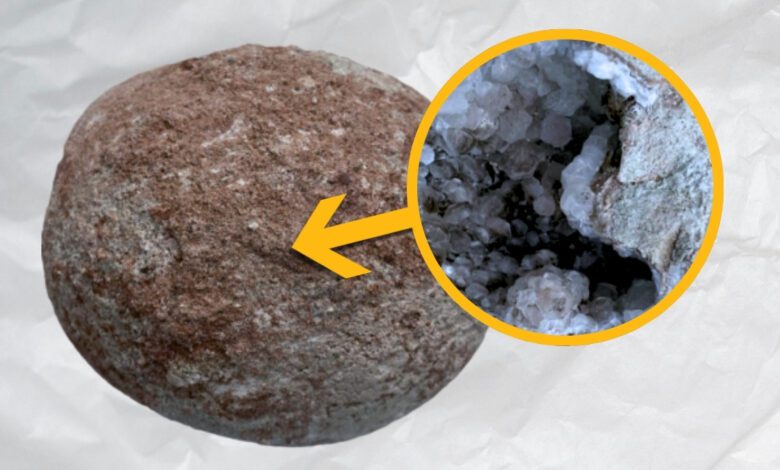
Paleontologists in China have made an unexpected discovery: inside one of the fossilized dinosaur eggs, estimated to be around 70 million years old, they found neither an embryo nor the usual deposits. Instead, the inner surface of the shell was covered with sparkling calcite crystals, forming a natural geode of sorts. The egg, about the size of a grapefruit, was found in the Chishan Formation in the Qianshan Basin, a site where ancient turtles, mammals, and birds are typically unearthed, but dinosaur remains are extraordinarily rare.
Scientists immediately noted the unusual structure of the shell. Analysis revealed it belonged to a previously unknown type of egg, which they named Shixingoolithus qianshanensis. This discovery opened a new perspective on dinosaur evolution and provided an opportunity to study the conditions under which such unique fossils formed.
A rare discovery
Alongside this egg, researchers found another belonging to the same oogenus—a special classification used for fossil eggs. However, neither contained any embryonic remains, and neither egg was linked to a specific dinosaur skeleton. This made it impossible to precisely identify the parent species. Nevertheless, the eggshell microstructure clearly points to dinosaurs, rather than other ancient animals such as reptiles or birds.
The process of crystal formation inside the egg drew particular attention. After the embryo died and the organic matter decomposed, groundwater rich in minerals seeped into the shell through microcracks and pores. Over time, dissolved substances settled on the inner walls, forming calcite crystals. This process is extremely rare and requires special burial conditions.
Significance for Science
The study of crystals inside fossilized eggs opens up new possibilities for paleontologists. Analyzing the composition of calcite not only helps date the find, but also reveals more about the chemical makeup of the water that entered the egg after burial. In turn, this helps reconstruct ancient ecosystems and the climatic conditions in which dinosaurs lived.
In recent years, scientists have increasingly used minerals formed inside fossils to learn more about Earth’s past. For example, calcite crystals recently made it possible for the first time to directly determine the age of a dinosaur egg. Such methods are becoming increasingly valuable in modern paleontology.
Unique Processes
Eggs filled with crystals are a genuine rarity. Typically, the inner cavity is filled with sedimentary rock or remains empty. The formation of minerals requires special conditions: an absence of organic matter, access to water, and a specific chemical environment. Such discoveries allow scientists not only to study the structure of eggs, but also to trace how geological processes have changed over millions of years.
Paleontologists note that these fossils are unique “time capsules” preserving traces of ancient waters, minerals, and even microscopic organisms. Each discovery is therefore unique and immensely valuable for science.
A Glimpse Into the Past
Crystals inside dinosaur eggs are just one example of how nature can surprise us. In various corners of the world, scientists have found bones coated with minerals or completely replaced by opal. These processes show just how diverse the pathways for the preservation of ancient remains can be.
Each such discovery not only sparks scientific debate, but also gives us a new perspective on the history of life on Earth. Researchers continue to study new samples in hopes of uncovering even more mysteries hidden deep within our planet.
In case you didn’t know, paleontologist Qing He from Anhui University and his team have been studying fossilized eggs and ancient reptiles for many years. Their work has been widely discussed within the scientific community. Thanks to their research, the world learned about new species of dinosaur eggs and unique aspects of their formation. Discoveries made in the Qianshan Basin have greatly contributed to our understanding of the evolution of ancient animals and their habitats.