Rising between Denmark and Sweden is a grand feat of engineering unlike anything else on the European continent. The Oresund Bridge-Tunnel has become a symbol of technological progress and international cooperation, linking two major cities—Copenhagen and Malmö. Its length, complex design, and unique engineering solutions have made it a true landmark of the region.
The construction of the Oresund link created a direct connection between the two countries, where previously there had been neither road nor rail access. Now, residents and visitors can easily cross the strait using this modern transportation artery. The bridge-tunnel serves not only as a vital transit route but also as an architectural masterpiece that draws the attention of millions every year.
Two levels and an artificial island
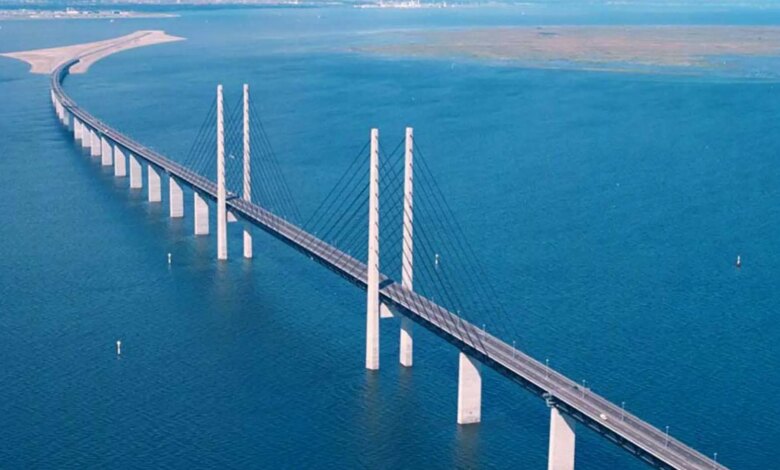
The main feature of the Oresund link is its two-level design. The upper deck carries a four-lane motorway, while below run two railway lines. The total length of the structure exceeds 11 kilometers—nearly 8 kilometers of which are bridge, with the remaining section as an underwater tunnel.
The bridge begins on the Danish side and stretches to the artificial island of Peberholm, which was created specifically for this project. The island serves as a link between the bridge and the tunnel, while also playing an important ecological role: rare species of plants and animals inhabit Peberholm, making it a unique nature reserve.
Architectural Solutions
The designers faced a challenging task: they needed to allow unhindered passage for ships while not interfering with air traffic near Copenhagen Airport. To achieve this, part of the crossing was built as a cable-stayed bridge with a central span of 490 meters, rising significantly above sea level. The height of the main pylon reaches 204 meters, and the structure weighs over 82,000 tons.
The route then goes underwater—a 3.5-kilometer tunnel runs beneath the seabed. This approach prevented conflicts with both marine and air transport, while also ensuring safe and reliable operation in any weather conditions.
A Transport Revolution
Since its opening, the Øresund Bridge-Tunnel has become a key element in Northern Europe’s transport infrastructure. Thousands of cars and trains cross it each day, connecting not only Denmark and Sweden but also facilitating transit across EU countries. Travel time between Copenhagen and Malmö has been reduced to 35 minutes, significantly boosting mobility and supporting the region’s economic growth.
The crossing’s infrastructure is designed to withstand heavy loads and meets the strictest safety standards. State-of-the-art monitoring, automatic traffic control, and emergency notification systems have been implemented here. As a result, the Øresund Bridge-Tunnel is considered one of the most reliable and technologically advanced structures in Europe.
Impact on the region
The arrival of the Øresund crossing has transformed the lives of millions. It has acted as a catalyst for integrating the labor, education, and cultural markets of the two countries. Many residents of Copenhagen and Malmö cross the border daily to work or study on both sides of the strait. In addition, the bridge-tunnel has attracted new investment to the region, boosted tourism, and strengthened international ties.
The architectural expressiveness and scale of the Øresund crossing have made it one of the main attractions in Scandinavia. Tourists from all over the world come here to witness this marvel of engineering and take in panoramic views of the Baltic Sea.
In case you didn’t know, the Øresund Bridge-Tunnel was opened in 2000 and has since remained the largest combined structure of its kind in Europe. The project was carried out by a consortium of Danish and Swedish companies, and its cost amounted to around 4 billion euros. The artificial island of Peberholm, created to connect the bridge and tunnel, has been designated a natural heritage site and is protected by law. Today, the Øresund crossing is not only a key transport artery, but also a symbol of unity and cooperation between Denmark and Sweden.