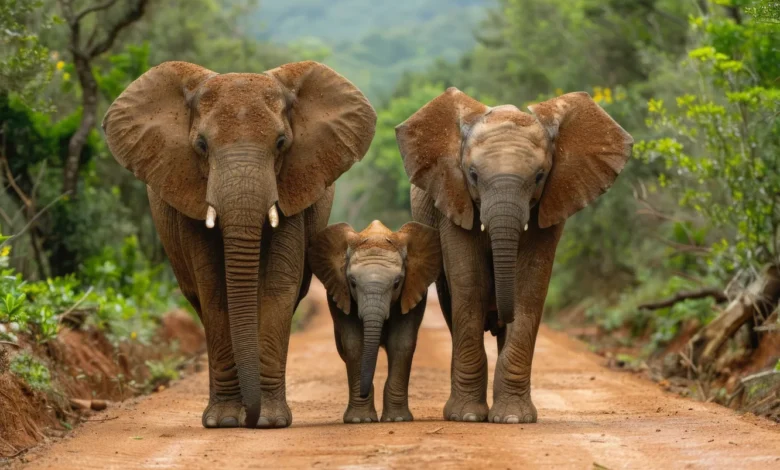
In some African countries, farmers have found an unusual way to protect their crops from elephants. Instead of fences and electric barriers, they use beehives, creating a living barrier in the animals’ path. This approach has proven effective in Tanzania and Kenya, where elephants have learned to avoid areas guarded by bee swarms. If an elephant happens to disturb a hive, the enraged insects immediately attack, forcing the giants to retreat.
However, in Botswana, which has the largest elephant population on the continent, this method has unexpectedly failed. The reason lies in the local climate: long dry spells, water shortages, and sparse vegetation have led to a decline in wild bee numbers. Here, elephants rarely encounter these insects and do not see them as a threat.
Experiment in the national park
To find out if bees truly fail to deter elephants in Botswana, scientists conducted an unusual experiment. Instead of real hives, they played audio recordings of buzzing bees, using white noise as a control. In one of the country’s national parks, researchers played these sounds when herds of elephants approached their resting area.
The animals’ reactions were mixed. Most elephants didn’t flee, but became alert, raised their heads, and listened intently to the unfamiliar noise. Only in a few cases did elephant families choose to leave the area after hearing the virtual swarm.
Why don’t bees scare elephants?
Experts explain that elephants in Botswana simply have no negative experiences with bees. Unlike their counterparts in Kenya and Tanzania, the local elephants have not encountered aggressive insects and therefore do not see them as a threat. Moreover, due to the declining bee population in the region, the chance of such encounters is minimal.
As a result, beehives here cannot serve as reliable protection for farmers’ fields. They act more as an additional barrier but do not fully solve the problem. Scientists are already exploring alternative ways to deter elephants and help local residents preserve their crops.
Searching for new solutions
One promising idea is the use of light barriers. Researchers plan to install special devices that emit bright flashes of light when animals approach. Preliminary data suggest that such signals can effectively deter elephants without causing them harm.
While experiments are ongoing, farmers in Botswana are forced to seek a compromise between protecting their fields and preserving the unique elephant population. The question remains open: will it be possible to find a universal solution suitable for different climates and animal behaviors?
In case you didn’t know, Botswana is considered the country with the largest elephant population in the world—with estimates suggesting around 130,000 animals live here. In recent years, the region has faced serious climate challenges affecting not only wildlife but also insects, including bees. Research into effective and humane ways to protect crops is ongoing, and farmers are hoping for new technologies that will help them coexist with the wild.