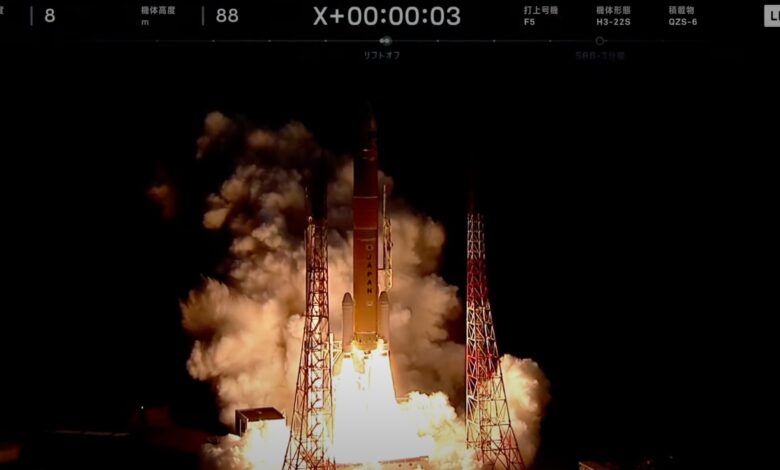
Tonight, Japan is once again in the spotlight of the global space industry as the H3 rocket launches from the Tanegashima Space Center, carrying the newest Michibiki 5 navigation satellite. This mission marks a significant step forward for the Japanese Quasi-Zenith Satellite System (QZSS), which has already proven its efficiency and reliability. The live broadcast of the event will begin at 8:15 PM Eastern Time, with the launch scheduled for 9:10 PM (11:10 AM local time in Japan on December 17).
Michibiki 5 weighs 4,800 kilograms and will become the fifth satellite in the QZSS constellation—a national navigation network operating in geosynchronous orbit. The system is compatible with the American GPS satellites, enabling their combined use for enhanced positioning accuracy. Thanks to this approach, QZSS is in demand not only in Japan, but also in Asia-Pacific countries with similar longitudes.
The first QZSS satellite was launched back in September 2010, when the experimental Michibiki 1 took to orbit—later replaced by the more advanced Michibiki 1R in October 2021. Since then, the system has gradually expanded, and today’s Michibiki 5 mission transforms QZSS into a fully-fledged five-satellite network. However, development will not stop there: in the future, the constellation is expected to grow to eleven satellites.
QZSS development
QZSS is not just an alternative to GPS, but an independent system capable of operating in challenging urban environments and rugged terrain. Japanese engineers have placed special emphasis on signal stability and accuracy, which is particularly important for megacities like Tokyo and Osaka. In addition, QZSS is actively used in transportation logistics, agriculture, and even emergency alert systems.
With the launch of Michibiki 5, the system’s capabilities will expand significantly. QZSS will now be able to provide even more stable coverage and increase the reliability of navigation services for millions of users. In the coming years, Japan plans to integrate QZSS with other global navigation systems to create a unified platform for precise positioning worldwide.
H3 Rocket: A New Chapter
A two-stage H3 rocket is being used to launch Michibiki 5 into orbit, replacing the legendary H-2A. The latter ended its career in June last year after 24 years of successful operation. The inaugural H3 launch in March 2023 was unsuccessful—the ALOS-3 satellite, intended for Earth observation, was lost. However, the JAXA team conducted a thorough review and upgrade after that, which enabled five successful missions since.
In February 2025, the H3 rocket had already delivered another Michibiki satellite into orbit, confirming its reliability and efficiency. Today’s launch marks the seventh mission for this rocket, and experts are confident in its success. The H3 is designed for medium payloads and can carry both navigation and scientific satellites into orbit.
The Future of Japanese Navigation
Japan is open about its ambitions in satellite technology. In the coming years, the country aims not only to complete the deployment of QZSS but also to offer its services to other regional nations. Negotiations are already underway with Australia, South Korea, and Southeast Asian countries for joint use of Japan’s navigation infrastructure.
Experts note that QZSS could become a key component for the development of autonomous vehicles, precision agriculture, and new safety services. Japanese companies are actively investing in creating applications that use QZSS data, opening up new opportunities for business and science.
In case you didn’t know, the Japanese space agency JAXA (Japan Aerospace Exploration Agency) is the country’s leading organization in space research and launches. The agency is involved not only in navigation projects but also in programs exploring the Moon, Mars, and other planets. QZSS is one of JAXA’s key projects, aimed at providing Japan and neighboring countries with high-precision navigation and communications. Michibiki is the name of the satellite series forming the backbone of this system, and each new launch strengthens Japan’s position in the global space technology market.