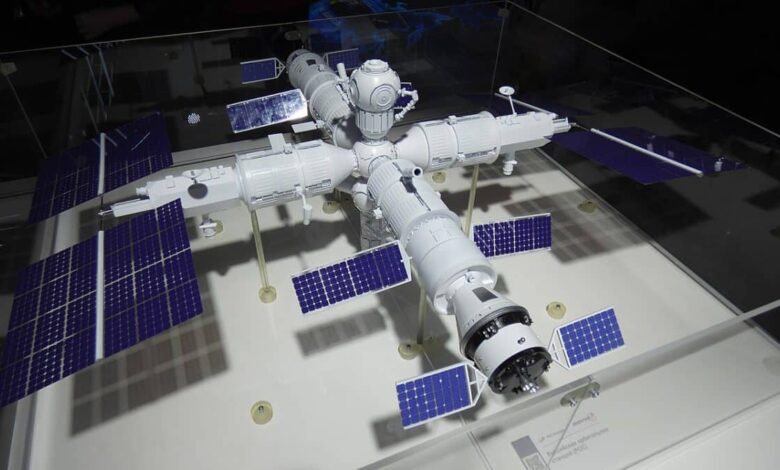
A major shift is underway in the Russian Orbital Station (ROS) project: scientists from the Russian Academy of Sciences (RAS) have proposed abandoning the nearly polar orbit with a 97-degree inclination in favor of the 51.6-degree angle, a trajectory more traditionally used in Russian space missions. This proposal was discussed at the V Congress of Young Scientists, attended by Roscosmos leadership and top industry experts. Following extensive debate, most specialists supported transitioning to the proven orbital solution, which will now require revising technical specifications and contracts to keep the project on schedule.
Previously, the new station was expected to be placed in an orbit with an inclination of about 97 degrees. This choice would have enabled observation of the entire territory of Russia, including the strategically significant Northern Sea Route. However, experts point out that such an orbit exposes the station to increased radiation and brings operational challenges that could jeopardize crew safety and equipment reliability.
In turn, an orbit with a 51.6-degree inclination has long been used in Russian crewed spaceflight and is considered safer and more technologically established. This approach reduces radiation risks and simplifies both technical maintenance and launch logistics. Now Roscosmos will need to review the academicians’ recommendations and make a final decision regarding the future station’s orbital parameters.
Arguments for changing the orbit
Proponents of switching to the classic inclination emphasize that it allows leveraging existing experience from operating the International Space Station (ISS), which also operates in a 51.6-degree inclined orbit. This choice provides more stable conditions for the crew and scientific experiments, and also facilitates integration of new modules and systems.
Additionally, reducing radiation exposure for the crew and equipment could significantly extend the station’s operational lifespan and lower maintenance costs. This is especially important given budget constraints and the need to strictly adhere to the construction and launch schedule for the modules.
However, the 97-degree inclination option also has its supporters. For example, The National Interest columnist Brandon J. Weichert noted that such an orbit gives Moscow access to strategically important regions of the planet for observation, which could be significant for national security and scientific research.
Impact on project timelines and objectives
Switching to a different orbit will require updates to technical documentation and contracts with contractors. This could affect the project timeline, but experts believe the benefits of the new plan outweigh potential drawbacks. In particular, using proven technologies and standard launch trajectories will help avoid many unforeseen issues during the station’s construction and operation.
In the near future, Roscosmos is expected to conduct an additional assessment of the proposed changes and coordinate them with key contractors. After that, a final decision will be made regarding the orbit parameters for the new Russian station. This issue is expected to be resolved within the next few months to prevent project delays.
International interest and prospects
The Russian orbital station project has attracted interest not just in Russia, but also abroad. Experts note that the choice of orbit could influence opportunities for international cooperation, as well as the scientific and practical objectives the station will address. Specifically, an orbit with a 51.6-degree inclination opens up opportunities for joint experiments with other countries participating in crewed space programs.
At the same time, the final decision on the station’s orbit will send an important signal to partners and contractors, defining the direction of Russia’s space program for decades to come. This choice will determine not only the safety and efficiency of the station’s operations, but also its role in the global space industry.
Speaking of Roscosmos
The Roscosmos State Corporation (State Corporation for Space Activities Roscosmos) is a key player in both the Russian and global space industries. Established in 2015 based on the Federal Space Agency, Roscosmos has since been responsible for implementing the country’s space policy, developing and launching launch vehicles and satellites, as well as piloted and automatic spacecraft.
Roscosmos coordinates the work of dozens of enterprises and research institutes, ensuring the fulfillment of national and international programs. Among its most prominent projects are participation in the creation and operation of the International Space Station, launching communication and navigation satellites, and developing new rocket technologies. In recent years, the corporation has been actively working on building its own orbital station, which is expected to mark a new chapter in the development of Russian space exploration.
The leadership of Roscosmos consistently emphasizes the importance of innovation and international cooperation, while striving to enhance the competitiveness of the Russian space industry on the global market. Despite challenges and difficulties, the corporation continues to implement ambitious projects aimed at strengthening Russia’s position in space.