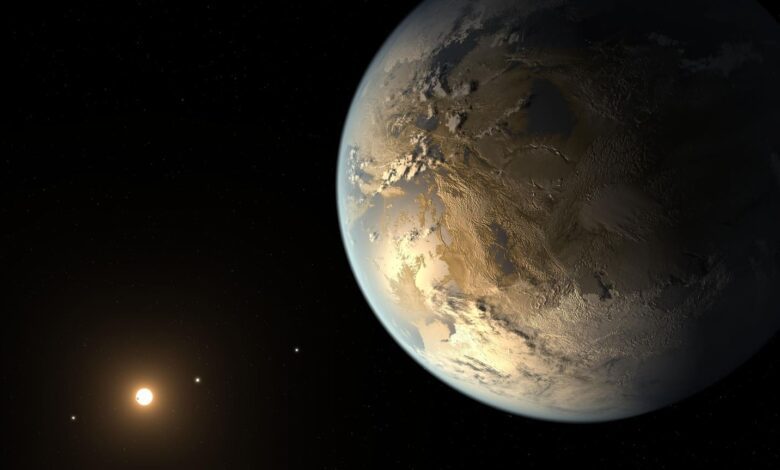
In the search for extraterrestrial civilizations, scientists are increasingly focusing not just on radio signals, but also on chemical traces that intelligent life might leave behind. Earth already stands out among other planets because of its atmospheric composition: it contains substances not found in nature, such as freons. These compounds are the result of human activity, and their detection on another planet would be a scientific sensation.
However, current telescopes are not yet capable of detecting such subtle signs over vast distances. That’s why researchers from the Robert Goddard Space Flight Center and the Blue Marble Space Institute of Science (USA) decided to take a different approach. They modeled what Earth might look like a thousand years from now under various civilization development scenarios, aiming to determine which technosignatures would be most noticeable to observers from other worlds.
Future scenarios
In their work, scientists examined ten possible futures for humanity. Each scenario revolves around key questions: which energy source will become dominant, whether space exploration will be a priority, and how the structure of society will change. In one scenario, the planet turns into an industrial giant where technology and industry permeate all aspects of life. In another, Earth becomes an ecological oasis with pristine air and minimal impact on nature. There are also more exotic options, such as a world where people live in massive city-states or rely entirely on renewable energy sources.
Each of these scenarios was considered as a separate hypothetical exoplanet. Researchers tried to determine which signs of civilization could be detected using future space observatories. Special attention was given to chemical compounds that may appear in the atmosphere as a result of industrial activity or agriculture.
Technosignatures and telescopes
In most of the simulated scenarios, Earth’s future atmosphere contains elevated concentrations of carbon dioxide and nitrogen dioxide. Such a combination may indicate active industrial combustion—a process difficult to explain without the presence of intelligent beings. According to estimates, these gases will be detectable by the Habitable Worlds Observatory, scheduled for launch in the 2040s. Additionally, this telescope may even be able to capture artificial city lights on the night sides of exoplanets.
Another promising project is the LIFE mission (Large Interferometer For Exoplanets). It is being developed to search for industrial gases, as well as signs of intensive agriculture. For example, a combination of nitrous oxide, methane, and ammonia may point to large-scale farming or livestock breeding. Such signals will only be available for analysis using the most advanced instruments, which for now exist only as concepts.
Invisible civilizations
However, not all civilization development scenarios leave visible traces. In some models, people switch entirely to ‘clean’ energy, and the atmosphere returns to its original state. In such cases, even the most sensitive telescopes won’t be able to detect any unusual chemicals or artificial lighting. This means that highly developed societies could remain invisible to outside observers if they consciously minimize their environmental footprint.
In such situations, there remains only one path — to search for signs of the exploration of other planets or outer space. Large artificial structures on the surfaces of nearby worlds or in near-Earth orbit could become the only evidence of the existence of a technologically advanced civilization.
The future of observations
To search for such objects, scientists propose using the principle of the Solar Gravitational Lens (SGL). The idea is to position a telescope at a distance of more than 540 astronomical units from the Sun. In this case, the Sun’s gravity acts as a giant lens, magnifying images of distant star systems. However, it is impossible to carry out such a project in the coming decades: even if launched in the near future, reaching the required point would take 50 to 100 years with modern propulsion systems.
Nevertheless, advances in technology and the emergence of new observatories are giving humanity unique opportunities to search for life beyond the Solar System. Each new instrument brings us closer to solving one of the Universe’s greatest mysteries: are we alone in the Universe?
If you didn’t know, the Blue Marble Space Institute of Science is an international nonprofit organization dedicated to research in astrobiology, planetary science, and the search for extraterrestrial life. The NASA Goddard Space Flight Center is one of NASA’s leading research centers, specializing in the development of space missions and new technologies for exploring the universe.