International analysts have released new estimates on the development of solar energy worldwide. According to their calculations, by the end of the decade, global photovoltaic capacity could approach 2.9 billion kilowatts. Most of the new installations will be concentrated in a limited number of countries.
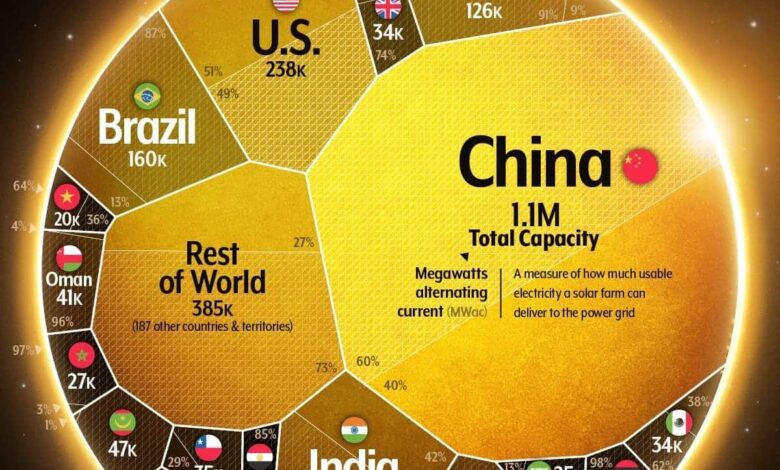
Nearly 80% of all ongoing and planned solar power plants are located in just fifteen countries. China plays the most prominent role, not only leading in the number of existing facilities but also continuing to accelerate the construction of new plants. China’s share in future global capacity is estimated at about 35%. In addition, Chinese companies supply most of the world’s components for solar panels, further strengthening the country’s position in the market.
The United States and India rank second and third in terms of upcoming solar projects. Both countries are implementing large-scale government programs aimed at promoting renewable energy. In the US, a range of measures supports investment and reduces taxes for producers, while India is pursuing a national strategy to increase the share of clean energy in its power mix. Despite their rapid growth, their combined figures are still almost half of China’s.
Other notable participants include countries from Europe, the Middle East, and Southeast Asia. Germany, Spain, Japan, and Australia continue to invest in major solar projects; however, their share of new global capacity is significantly lower than that of the leaders. Some regions are experiencing a surge of interest in solar energy amid rising prices for traditional energy sources and efforts to reduce greenhouse gas emissions.
Experts point out that the development of solar energy largely depends on the availability of technology, equipment costs, and government support. In the coming years, further decreases in the cost of solar panels and improvements in their efficiency are expected, which may accelerate the rollout of new projects in developing countries.
Thus, by 2030, the global solar power landscape will have changed significantly. China will maintain its lead, while the US and India are set to strengthen their positions. Other countries will strive to keep up, adopting innovative solutions and expanding their own capacity.