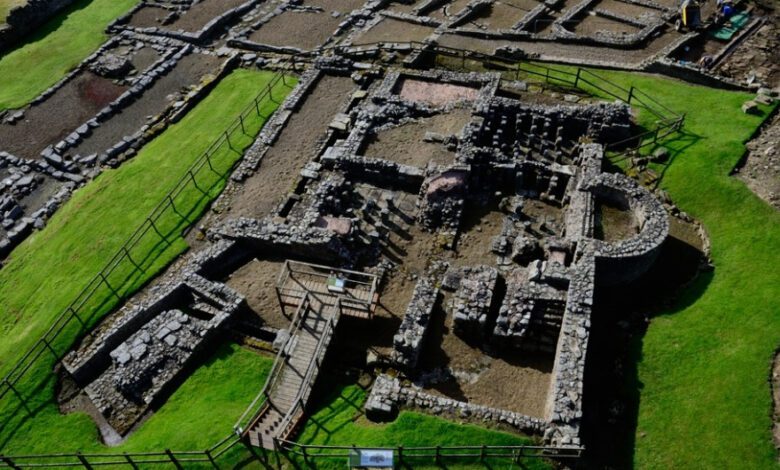
In the north of England, among the green hills of Northumberland, lie the ruins of Vindolanda—a Roman fort once standing on the very edge of the empire. Built around 85 AD, this military camp was established to defend the borders from raids by northern tribes. Today, Vindolanda is renowned not only for its walls and artifacts but also for unique discoveries that shed light on the daily lives of Roman soldiers and their families.
A recent study by an international team of scientists has added an unexpected detail to the fort’s history. Paleoparasitologists examined samples of ancient deposits collected from the drainage system leading from the Roman baths. The results were striking: the samples contained preserved eggs of roundworms, whipworms, and traces of intestinal giardia. These findings indicate that the inhabitants of Vindolanda faced serious sanitation issues, despite having advanced infrastructure for their time.
Ancient baths
Archaeologists discovered the remains of two bath complexes within the fort, dating from different periods in Vindolanda’s history. One was built in the early years, the other in the third century. It was in the drainage system, leading from the latrine of the later baths, that specialists found valuable samples for analysis. In 2019, dozens of these samples were sent to laboratories in Cambridge and Oxford, where they were carefully examined for parasites.
In 14 out of 50 samples, researchers identified eggs of roundworms—Ascaris (Ascaris sp.) and whipworms (Trichuris sp.). Additionally, immunoassay analysis of one sample confirmed, for the first time in Roman Britain, the presence of intestinal Giardia (Giardia duodenalis). These protozoa cause giardiasis—an illness that can seriously undermine health even today.
Sanitary realities
The parasites found in Vindolanda are primarily spread via the fecal-oral route. This means infection occurred through contaminated water, food, or unwashed hands. Although the Romans were aware of the problem of intestinal parasites, the medicine of that era could not offer effective treatments. As a result, outbreaks of infections could reduce the garrison’s combat readiness and worsen the overall health of the fortress inhabitants.
Interestingly, similar findings have been documented at other ancient archaeological sites. For example, in Sicily, numerous whipworm eggs were discovered in an ancient vessel found in the ruins of a bathhouse complex. This confirms that sanitation problems were typical of many regions of the Roman Empire, regardless of their distance from the center.
Archaeological discoveries
Excavations at Vindolanda have been ongoing for over a century, with new discoveries made every year. In addition to parasites, archaeologists have uncovered wooden tablets with everyday and household records, domestic items, and curious artifacts. A few years ago, researchers unearthed a stone slab depicting a phallus and a mocking inscription addressed to someone named Secundinus. Finds like these provide a glimpse into the lives of Roman soldiers from both an official and a very personal perspective.
Vindolanda has become a true treasure trove for historians and archaeologists. Not only walls and artifacts, but also organic materials have survived here—a rarity for sites of this age. Thanks to this, researchers can reconstruct not just events, but also the everyday concerns, joys, and ailments of people who lived on the empire’s frontier.
Life on the Frontier
The Vindolanda fort was located just south of the famous Hadrian’s Wall, which served as a symbol of power and a boundary between civilization and the wild lands beyond. Despite its distance from Rome, life flourished here: soldiers, their families, craftsmen, and merchants formed a unique community. However, even the advanced infrastructure could not prevent diseases from spreading in cramped conditions with limited access to clean water.
Paleoparasitological research offers a fresh perspective on the challenges faced by inhabitants of Roman garrisons. It turns out that even the most advanced engineering solutions could not fully protect people from invisible threats lurking in the sewers and water supply.
Incidentally, Vindolanda is one of the most renowned archaeological sites in Roman Britain. Large-scale excavations are regularly conducted here, and the discovered artifacts are displayed in the local museum. The fortress became famous for its unique wooden tablets, considered a key source on the daily life of Romans on the empire’s frontier. Studies like this one help us better understand the difficulties people faced in the past, and why sanitation issues remained critical even for ancient civilizations.