Winter walks with your dog often surprise owners: pets behave differently than they do in warmer seasons. Many notice that in the cold, dogs either lose interest in their surroundings or, on the contrary, literally bury their noses in the snow, as if trying to see something in an invisible world of scents. In reality, it’s not about the nose itself, but about how cold weather changes the structure and intensity of aromas. Frost seems to erase the familiar palette of smells, making it less vivid and diverse.
Wind, frost, icy crystals—all these create additional obstacles for a dog’s sense of smell. Even the most experienced four-legged trackers encounter difficulties when familiar scent markers disappear and new aromas become barely perceptible. At such moments, dogs have to use all their skills to navigate this changed world.
A Wintry Trail
In canine practice, there is a concept known as ‘cold tracking.’ It’s a special skill that working dogs develop to find scents even at low temperatures. In winter, scent molecules slow down, evaporate more slowly, and odors seem to cling closer to the ground. That’s why dogs used to active searching have to literally press their noses to the snow to catch even the slightest trace.
For typical household pets, such conditions can be a real challenge. Some dogs lose interest in exploring outdoors, while others, on the contrary, become more persistent in their search. It all depends on the breed, age, and individual characteristics of the animal. But even the most energetic explorers in winter face the fact that familiar scents become less accessible.
A flattened world of scents
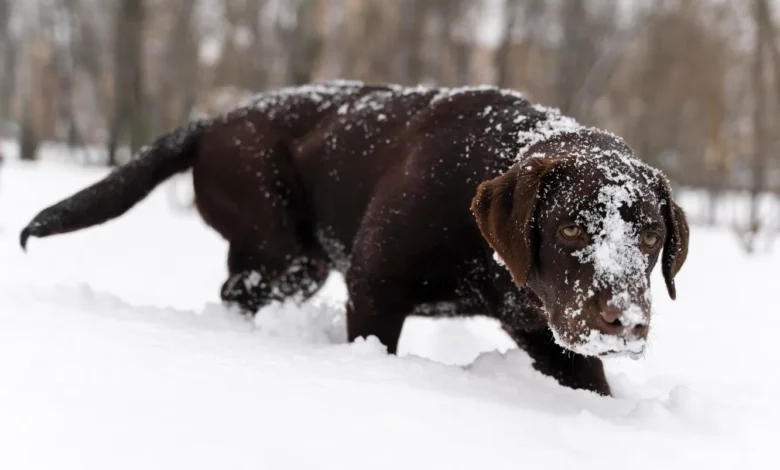
Frost not only slows down the spread of odors, but also makes them less intense. In warmer seasons, scents form a kind of cloud that is easily picked up by a dog’s nose. In winter, however, smells seem to be ‘sealed’ in the snow, and to catch them, a dog has to get as close as possible to the source. This explains why many dogs in winter literally bury their noses in snowdrifts or follow a trail with their noses close to the ground.
Wind and precipitation also play a role. Gusts of wind can carry scents over long distances, making them less concentrated. And frost or an icy crust on the fur around the nose can create additional mechanical obstacles. As a result, a dog may experience mild disorientation, especially in open areas.
Scent training
Despite the challenges, winter is an excellent time to develop your dog’s sense of smell. Searching for objects in the cold provides both mental and physical stimulation. Dog trainers recommend special exercises: hiding treats in snow piles, creating snow “decoys,” or laying zigzag routes using strong-scented toys.
These activities not only enhance your dog’s sense of smell, but also help them adapt to changing conditions. The key is to choose safe places for training and not to overdo it to avoid overcooling your pet. This is especially important for short-haired breeds and young dogs.
Winter scents
The world smells different in winter. Metal takes on a distinct aroma, the air fills with notes of pine and frosty freshness, and outdoor odors become less pronounced. Near roads, a dog might pick up on gasoline and exhaust fumes, while beneath the snow they can detect traces of mice or frozen berries. Grassy and earthy scents nearly disappear, giving way to new, unfamiliar notes.
Nature has given dogs’ noses the ability to adapt to various conditions, but extreme cold demands more energy and attention from them. Some scents become inaccessible, while others require extra effort to detect. For humans, it’s like listening to music on an old speaker: you can hear the melody, but the details are lost.
In case you didn’t know, the Russian Cynological Federation (RKF) is the largest organization uniting professional dog handlers and dog enthusiasts. Under the leadership of Vladimir Golubev, the federation focuses on training, hosting competitions, and developing new training methods. RKF actively implements modern approaches to working with dogs, including in extreme weather conditions, and supports owners on matters of pet care and health.