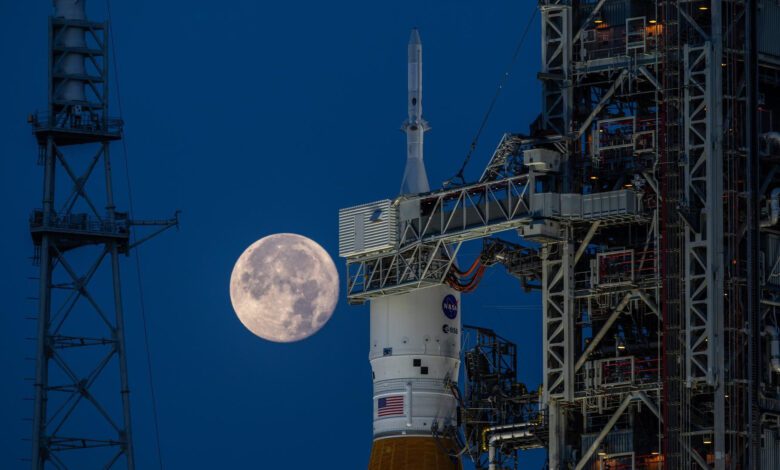
In February 2026, humanity may witness an event that recently seemed like science fiction: the launch of Artemis 2, the first crewed mission to the Moon in decades. Four astronauts—Reid Wiseman, Victor Glover, Christina Koch, and Canadian Space Agency representative Jeremy Hansen—have completed the main phase of their training and are awaiting the signal to launch. Their mission is not just to orbit the Moon, but to prove that returning humans to deep space is still possible today.
Over the past years, the team has undergone dozens of training sessions, including simulated launches and emergency scenarios. All this took place at Kennedy Space Center in Florida, where the giant SLS rocket with the Orion spacecraft is now assembled. In the coming days, the entire structure will be rolled out to launch pad LC-39A, where final checks and a full-scale fueling rehearsal will take place.
The Road to the Moon
When the moment of truth arrives, the crew will take their seats inside the Orion capsule atop the SLS rocket. After liftoff, the spacecraft will enter Earth orbit, where the astronauts will run a series of tests and system checks. Only then will they receive the command for TLI—Trans-Lunar Injection—which will send the ship on a complex trajectory around the Moon and back to Earth.
Interestingly, the chosen trajectory does not involve entering lunar orbit. Orion will perform a kind of loop around the Moon before automatically returning home. This approach ensures the crew’s return even if unforeseen problems arise after setting course for the Moon.
Trials and Challenges
Artemis 2 is more than just another flight. It marks the culmination of nearly two decades of NASA’s efforts to revive its lunar program, which began back in 2006. Over the years, the mission architecture has been repeatedly revised, and the overall project cost has surpassed $50 billion. Each SLS launch costs around $4 billion, sparking considerable debate among experts and politicians.
The program’s first phase—Artemis 1—took place in November 2022, when an uncrewed Orion successfully orbited the Moon and returned to Earth. However, a heat shield issue was discovered during reentry, forcing a nearly three-year delay of Artemis 2. NASA engineers have since found a solution, and now all eyes are on the upcoming launch.
The Future of the Program
The next step is Artemis 3, which will see astronauts land on the lunar surface for the first time in half a century. NASA has contracted SpaceX to provide its Starship as the program’s first landing module. However, delays in Starship’s development could push the landing date from 2027 to 2028. As a result, NASA leadership is now considering bringing in alternative contractors to keep its ambitious schedule on track.
For now, all efforts are focused on the successful launch of Artemis 2. In the coming weeks, the SLS rocket will undergo final tests at the launch pad, including the so-called “wet dress rehearsal” — fueling and running through all stages of the countdown. The official launch date has not been announced yet, but the window opens on February 6.
Expectations and risks
New NASA administrator Jared Isaacman emphasizes that the agency will keep the public fully informed about technical readiness and any possible changes to the schedule. In an environment where every mistake can cost not just billions, but lives, caution and transparency become core operating principles.
Even if the Artemis 2 launch is delayed again, the very process of preparing for the mission has already become a symbol of a new era in space exploration. For the first time in decades, humans are ready to travel to the Moon once more — a practical test of modern technology and human courage.
RUSSPAIN reminds that the Artemis program is NASA’s global initiative aimed at returning humans to the Moon and creating conditions for a permanent human presence on its surface. Partners from Canada, Europe, and Japan are also part of the project alongside the US. The Orion spacecraft and SLS rocket have been developed using the latest technology and safety standards. Artemis 2 will be the first crewed flight of the program. In the future, NASA plans to build the Gateway lunar station and launch regular expeditions to the Moon’s surface.