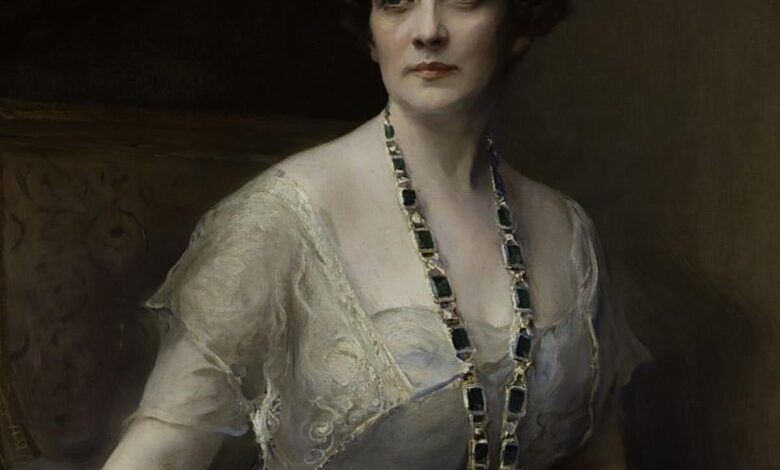
The disappearance of one of Europe’s most recognizable tiaras remains a topic of debate among historians and collectors. Created by Cartier at the request of a wealthy American woman, this piece became a symbol not only of luxury but also of change within European monarchies. After its owner’s death, the fate of the tiara became shrouded in mystery, and its possible appearance at auctions is still widely discussed.
In the early 20th century, American May Stewart, later known as Princess Anastasia of Greece, entered the Greek royal family through her marriage to Prince Christopher. Her path to nobility was far from simple: two marriages, a scandalous divorce in her youth, and a vast inheritance after the death of her second husband, industrialist William Leeds. This fortune enabled her to rise into the highest circles of European society and commission from Cartier a unique kokoshnik-style tiara, adorned with diamonds and pearls.
As reported by Mujerhoy, the piece stood out not only for its exquisite design but also for its historic context. The inspiration for the tiara came from Russian traditions and the famed jewels of the Romanov dynasty. Anastasia was often depicted wearing the tiara in portraits and featured in society magazines of the time, emphasizing her new place among Europe’s elite. However, due to political upheaval and the exile of the Greek royal family, the tiara was never seen at official ceremonies.
Tragedy and legacy
Anastasia’s own fate turned out to be just as dramatic as the story of her jewelry. After many years of anticipation and fighting prejudice, her wedding to Prince Christopher only took place in 1920. Despite resistance from the royal family, the American’s wealth and personal qualities played a decisive role in her acceptance. She converted to Orthodoxy and took a new name, joining the ranks of European aristocracy.
But happiness was short-lived: just three years after the wedding, Anastasia died of cancer at the age of 45. Her death was not only a personal tragedy for her family, but also raised many questions about the fate of her possessions. According to her will, the inheritance went to her only son and husband, but the exact fate of the Cartier tiara remains unknown. In 1926, Cartier was commissioned to sell part of the jewelry, but the traces of the tiara disappear.
Connections with European dynasties
The history of the jewelry is closely intertwined with the destinies of many famous families. Anastasia’s son, William Leeds Jr., married Grand Duchess Xenia Georgievna, further strengthening the ties between the Greek and Russian aristocracy. The tiara, inspired by Russian motifs, became a symbol of cultural and historical union. Its disappearance sparked numerous rumors: some believe it may have been sold to private collectors, while others think the piece is still kept in one of Europe’s noble families.
Experts note that such pieces rarely appear on the open market, and their history often becomes a subject of speculation. Anastasia’s tiara is more than just a piece of jewelry—it’s part of cultural heritage, reflecting the complex interplay between wealth, power, and personal destiny.
A mystery that won’t let go
Today, interest in the fate of the Cartier tiara remains strong. Collectors and historians are still searching for traces of the piece, while any possible auction appearance would cause a global sensation. The story of Anastasia of Greece serves as a reminder of how personal dramas and historical upheavals can reshape the fate of even the most precious relics.
The question of the tiara’s whereabouts remains unanswered. Perhaps it has vanished from sight forever, or maybe one day it will resurface to tell a new chapter in European history.
Princess Anastasia of Greece, born May Stewart, became one of the most striking figures in early twentieth-century European monarchy. Her life is an example of how personal determination and wealth can change the fate not only of an individual, but of entire dynasties. Through her marriage to Prince Christophoros and her unique taste, she left a significant mark on the history of jewelry art and aristocratic tradition. Her enigmatic Cartier tiara is still considered one of the most coveted and mysterious relics among collectors and historians.