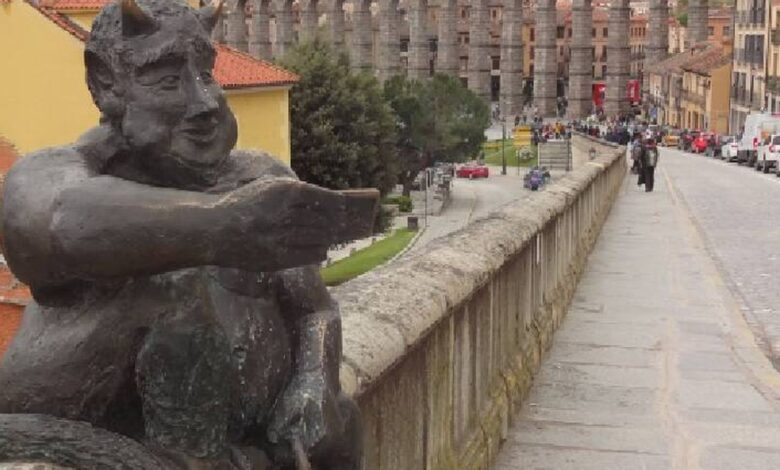
In the very heart of Segovia, near the ancient aqueduct, a new landmark has emerged that quickly became one of the most talked-about attractions in the region. We’re talking about a bronze sculpture depicting the devil taking a selfie in front of the historic monument. This piece has not only changed the traditional look of the urban landscape, but also sparked fierce debates among locals and visitors.
Since its installation in 2019, the statue has become a magnet for tourists and a hot topic of debate. Some see it as a humorous, modern take on a city legend, while others view it as a provocation or even a threat to traditional values. The unusual monument quickly became shrouded in rumors and has turned into a symbol of the cultural shifts happening in Segovia.
The devil with a phone
The sculptor, artist José Antonio Abella, has created a figure that is hard to mistake for anything else. His devil is not frightening but rather a comical character, with rounded shapes, expressive features, and a signature smirk. In one hand, he holds a smartphone, and in the background stands the majestic aqueduct, posing as if for the photo.
The level of detail is striking: from the curved horns to the massive hooves, every feature is meticulously crafted. However, despite its grotesque appearance, the sculpture’s expression shows neither malice nor aggression. On the contrary, the devil looks more like a character from a children’s tale—cunning but harmless. It is precisely this sense of duality that has triggered such a strong public reaction.
Urban legend
The monument’s appearance is linked to one of Segovia’s most famous legends. According to the tale, a young girl, tired of carrying water uphill, made a deal with the devil: if he built an aqueduct in a single night, she would give him her soul. The demon worked all night but failed to place the last stone slab before sunrise. The girl was freed, and the city gained a unique architectural landmark.
The sculpture references this story, but does so with irony. Instead of a fearsome demon, it features a genial character seemingly more concerned with taking a selfie than with the eternal struggle of good and evil. This playful take sparked mixed reactions: some saw it as a fresh perspective on tradition, others as blasphemy and mockery of religious sentiment.
Public Response
The installation of the monument was surrounded by real controversy. Opponents accused city authorities of promoting ‘Satanism’ and even filed lawsuits. Some religious groups demanded its immediate removal, arguing that the devil could not be a symbol for a city with such a rich history.
Nevertheless, most locals and tourists embraced the new monument enthusiastically. The sculpture quickly became a popular photo spot, and the devil himself—an unwitting hero of memes and souvenirs. Despite the protests, city officials decided to keep the statue in a prominent place, highlighting that art should provoke discussion and reflect the zeitgeist.
A New Attraction
Today, the bronze devil with a phone is one of Segovia’s most recognizable landmarks. It often appears on tourist postcards, and guides include the statue as a must-see on city tours. The sculpture has become a symbol of modern Segovia and a striking example of how art can transform the perception of familiar places.
Relocating the statue to a busier square has only increased public interest. Now, anyone can take their own selfie with the devil, striking his iconic pose. For many visitors, this has become a kind of ritual, while locals see it as a source of pride and good-natured jokes.
José Antonio Abella is a Spanish sculptor renowned for his unusual works in public spaces. His style is marked by a blend of humor, irony, and deep respect for local traditions. With the Segovia devil, the artist not only reinterpreted an old legend but also created a new cultural symbol that unites generations and perspectives. His art continues to spark debate, which is exactly what makes his works truly vibrant and relevant.