When we think of one of the Canary Islands, the imagination usually conjures up endless sand dunes and turquoise waves of the Atlantic. However, hidden within this sun-scorched land are places where time seems to stand still. One such place is the unremarkable walking trail SL FV 27, which branches off the main Camino Natural route and invites travelers on a short yet incredibly rich adventure. This journey is not just across rocky ground, but into the very heart of the island’s history and nature, beginning in the small town of Vega de Río Palmas.
This valley received its name back in the 15th century from Norman conquerors, who were struck by the abundance of palm groves and springs in this arid land. It is from here that the dirt road begins, gradually descending to the bed of a dried-up river. Travelers are greeted by an unexpected green corridor. Dense thickets of Canary Island date palms (Phoenix canariensis) and tamarisk (Tamarix canariensis) create a striking contrast to the surrounding landscape. This green enclave is a true gift of nature, a breath of freshness amid the rocky desert, serving as the gateway to the main wonder—the granite gorge of Las Peñitas, one of the island’s most photographed and stunning locations.
Further progress continues along the right edge of the canyon, leading the traveler into a labyrinth of giant granite boulders. These rock formations are among the oldest geological strata not only on this patch of land but across the entire Canary archipelago. Millions of years of wind erosion have shaped them into whimsical sculptures that change color depending on the sun’s position. This place has a unique energy, with a silence broken only by the cries of birds of prey. The canyon is home to many bird species, adding a touch of wildlife observation to the walk. A well-marked path makes navigation easy and safe, allowing visitors to fully immerse themselves in the majesty of the landscape.
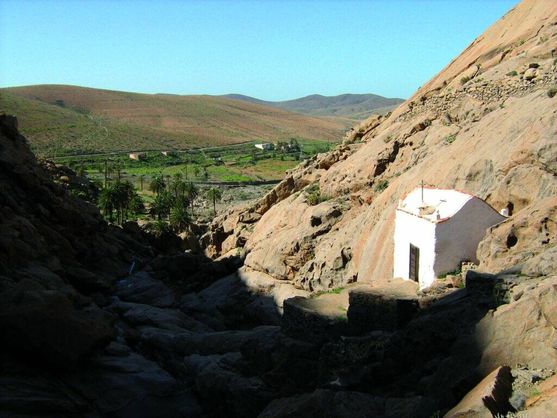
After passing through a granite fissure and crossing the small Las Peñitas dam, the traveler reaches the final destination of the journey. Nestled in the rock is a tiny, snow-white chapel—Ermita de la Peña. It was built in the 18th century by locals in honor of the island’s patroness, the Virgin Mary of Peña. A beautiful legend is associated with this place. According to tradition, a small alabaster statue of the Virgin Mary, only 23 centimeters tall, was brought to the island by the Normans back in 1402. During pirate raids in the 16th century, it was hidden in this secluded canyon to protect it from looting. In 2007, the chapel was declared a Site of Cultural Interest. Its simple architecture—whitewashed stone and lime walls, and single-nave design—stands out against the rugged landscape, symbolizing the resilience of the locals’ faith and spirit.
Today, this easy hike has become one of the best ways to discover the soul of the island, hidden from most tourists. Its easy access, incredible contrast between the green enclave and ancient cliffs, along with the cultural and spiritual significance of the destination, make this adventure a brief but deeply memorable experience. It is proof that beyond the popular beach resorts, another reality exists—where nature and human memory intertwine, creating unique and unforgettable places.