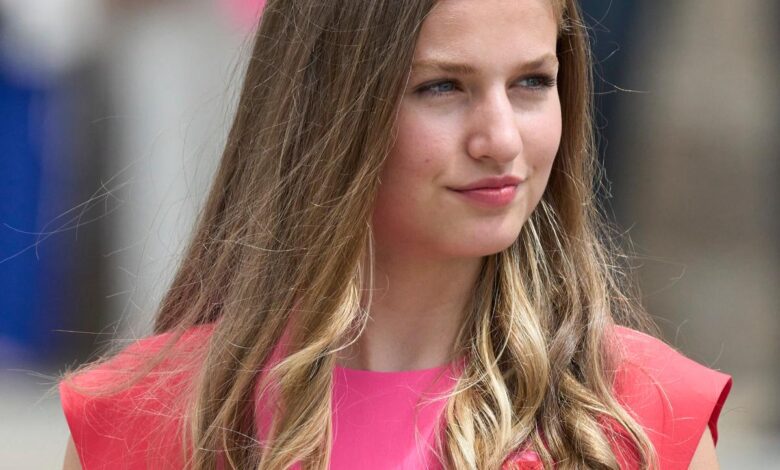
The appearance of Princess of Asturias Leonor, the future queen of Spain, continues to attract considerable interest. As she grows older, the features of the heir to the throne evolve, and observers find new resemblances to her numerous royal ancestors from the dynasties of England, Prussia, France, Greece, and Denmark. In recent years, her likeness to two great-great-grandmothers, whose destinies are closely linked to European history, has become particularly noticeable.
During her teenage years, many noted Leonor’s striking resemblance to her maternal great-great-grandmother, Princess Victoria Luisa of Prussia (Victoria Luisa de Prusia). The only daughter of Kaiser Wilhelm II and grandmother of Queen Sofía, she had the same fair hair, blue eyes, and delicate facial features. Her wedding to Ernst August of Hanover in Berlin in 1913 was the last major gathering of European monarchs before the outbreak of World War I.
Victoria Luisa, granddaughter of Queen Victoria of the United Kingdom, was born in Potsdam in 1892. She was the youngest of nine children and her father’s favorite. Contemporaries described her as intelligent and strong-willed; she loved nature and was even given the honorary rank of colonel of a hussar regiment. After the monarchy fell, the family lost their titles, but Victoria Luisa lived a long life, passing away in 1980, outliving all her brothers.
However, over the years, Princess Leonor’s resemblance to her Prussian great-great-grandmother has become less apparent. Now, in 2025, the heiress’s appearance increasingly reflects the features of another relative — Louise of Orléans (Luisa de Orleans), the maternal grandmother of honorary King Juan Carlos. Many believe it is her fair skin and facial shape that the future Queen of Spain has inherited.
Louise of Orléans was born in Cannes in 1882 to the Count of Paris, a pretender to the French throne. Her mother, Maria Isabella of Orléans, was the granddaughter of Spanish King Ferdinand VII, forging Louise’s ties to Spain from an early age. She spent part of her youth with her mother in Seville, while her father lived in England.
Louise became a member of the Spanish royal family in 1907 after marrying Infante Carlos Tancredo de Borbón-Dos Sicilias (Carlos Tancredo de Borbón-Dos Sicilias). For the Infante, this was his second marriage: his first wife, the Princess of Asturias María de las Mercedes and sister of King Alfonso XIII, died tragically in childbirth. For this union, Carlos Tancredo renounced his rights to the throne of the Kingdom of the Two Sicilies, gaining Spanish citizenship and the title of Infante.
Louise and Carlos Tancredo had four children, including María de las Mercedes — mother of future King Juan Carlos. The family settled in Madrid at the Palacio de Villamejor, which today houses one of the ministries. However, the proclamation of the Second Republic in 1931 forced them to leave the country. They lived in exile in Rome and Switzerland.
After the end of the Spanish Civil War, the family was able to return and settled in Seville. It was here that Luisa of Orléans spent the remainder of her days, raising children and grandchildren. She passed away in 1958 and was buried in the Church of the Divine Savior (Iglesia del Divino Salvador) in Seville. Thus, in Princess Leonor’s appearance today, one can see not only her northern, Prussian roots reflected, but also the Franco-Andalusian heritage of her ancestors.