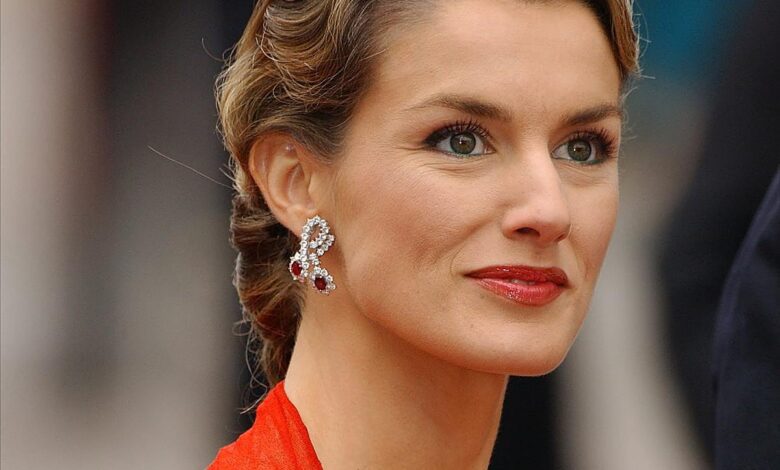
In May 2004, all of Europe’s attention was on Copenhagen: the wedding of Crown Prince Frederik and Mary brought together royals from across the continent. It was here that Spain’s future queen made her first major international appearance, just days before her own wedding. Letizia Ortiz, then still the fiancée of the Prince of Asturias, chose a vibrant red dress by Lorenzo Caprile for the occasion—a look still remembered as one of the Spanish royal family’s most striking moments.
But it wasn’t just the outfit that turned heads. The real attention was on her jewelry: short earrings and two ruby and diamond brooch clips, which Letizia attached at the corners of the dress’s square neckline. These brooches were far more than a simple accessory—they represented a dynasty and decades of history.
A royal jewel’s story
The ruby clips that shone on Letizia that evening once belonged to María de las Mercedes, Countess of Barcelona—the grandmother of King Felipe VI. She received them as a wedding gift from King Alfonso XIII when she married Infante Don Juan. Commissioned from the Parisian house of Chaumet, these brooches became a symbol of style and status, as well as an example of the Art Deco jewelry of their era.
The design of the piece was striking: six large rubies, framed by diamonds of various cuts, formed a complex geometric pattern with spirals and filigree lines characteristic of the 1920s and 1930s. The brooches could be worn together or separately, making them versatile for a wide range of occasions.
Family Heirlooms
María de las Mercedes was often seen wearing these brooches at official events. They accompanied her at weddings, christenings, and receptions, becoming part of the visual history of the Spanish monarchy. Interestingly, despite the tradition of passing down jewelry through the female line, these clips remained exclusively with the Countess of Barcelona for many years. Neither her daughter nor her daughter-in-law received them for public appearances.
There was also another part of the set—a ruby bracelet—which, unfortunately, was stolen during the couple’s honeymoon in the United States. Nevertheless, the clip brooches remained María’s favorite piece and often appeared in the pages of Spanish newspapers and magazines.
Journey to Letizia
After the death of the Countess of Barcelona, the jewelry collection was passed on to King Juan Carlos. However, his wife, Queen Sofia, was never seen wearing these brooches in public. For many years, they were kept in the royal vault until 2004, when Letizia chose them for her first major appearance as the future princess.
The choice was no accident: the brooches perfectly complemented the elegant neckline of the dress, adding to the overall look without being overwhelming and highlighting the status of the young woman who was about to become part of the royal family. Despite their age, the jewelry looked fresh and modern, becoming a real discovery for the public.
Disappearance from the spotlight
Since Letizia stunned the public in Denmark, these brooches have not reappeared at official events. Not a single member of the royal family has worn them at receptions or celebrations. The reasons behind their disappearance remain a mystery: perhaps the jewels are waiting for a special occasion or a new heir.
Debate continues in royal circles over who will inherit this heirloom. Some believe the brooches may go to one of the king’s sisters—Elena or Cristina. Others are convinced that Queen Letizia herself will bring them back into the spotlight when the time is right.
For now, the jewels remain a symbol of continuity and mystery, and their story is a reminder of how family heirlooms can disappear from view, only to amaze the public again someday.
RUSSPAIN reminds readers that Queen Letizia Ortiz Rocasolano became the wife of King Felipe VI in 2004 and has since repeatedly surprised the public with her bold fashion choices. Her style is frequently discussed in both Spanish and international media, while her jewelry selections are a subject of special interest for experts in royal gems. Jewelry from the Bourbon family collection is traditionally regarded not only as a symbol of power but also as part of Spain’s cultural heritage.