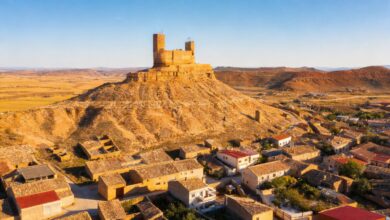
In the very heart of Spain, on the harsh and windswept lands of the province of Soria, lies an archaeological site that offers a new perspective on the history of the Iberian Peninsula. It is often compared to the famed Pompeii, buried under the ashes of Vesuvius, but this comparison is only partly accurate. Termes, or Tiermes as it is known, was not a victim of nature’s wrath. Its story is an epic saga of resilience, cultural fusion, and ingenious engineering, all carved into the malleable red sandstone.
Fortress in the Red Rock
Long before the Roman legions set foot on these lands, the Celtiberian civilization flourished here. They chose this strategically positioned plateau for their settlement. Instead of erecting walls, they took a different approach—carving into the very rock itself. The soft sandstone allowed them to create entire districts, where homes, utility buildings, and public spaces were hewn directly from the hillside. This unique architecture, reminiscent of a giant anthill, earned the settlement its unofficial nickname. Life in these cave dwellings offered many advantages: they stayed cool in summer, retained heat in winter, and—most importantly—served as an impregnable fortress. Each family had its own multi-level home, connected to neighboring ones by a complex network of corridors and stairs carved into the stone. This was a true vertical city, naturally integrated into the landscape.
The Arrival of Eagles and Transformation
Termes became one of the last strongholds of Celtiberian resistance against the mighty Roman Empire. Its fall marked a new era in the city’s history. However, the Romans, known for their practicality, did not destroy what had been built before them. They recognized the uniqueness and potential of this site. A large-scale reconstruction and Romanization began. Classical Roman structures were erected on the site of old Celtiberian buildings. A forum—the center of public and political life—appeared, along with baths, taverns, and spacious villas for the nobility, such as the famous “House with the Aqueduct.” But what is most striking is how Roman engineers integrated their technology into the existing rocky landscape. They didn’t just build next to it; they enhanced and improved what was already there. This led to a remarkable symbiosis of two completely different architectural traditions, making Termes truly unique.
A Walk Through the Streets of the Past
Today’s visit to Termes is a true journey into history. You can spend hours wandering along stone-carved streets, peering into the empty eyes of rock-hewn houses. One of the most impressive structures is undoubtedly the southern amphitheater, or “Graderío.” The rows of seats carved into the hillside still spark debate among historians about their original purpose. Was it a venue for theatrical performances, gladiatorial contests, or perhaps a sacred space for religious rituals? No less striking is the “Puerta del Sol” (Gate of the Sun)—the monumental entrance to the city, still showing deep ruts worn by carts that passed through here for centuries. But the real marvel of engineering is the complex water supply system. The Romans dug kilometers of channels and aqueducts into the rock to provide the city with clean water, and part of this system can still be seen. This is a place where history is not just set in stone—it continues to breathe, telling visitors about the lives of those who once called this rock their home.