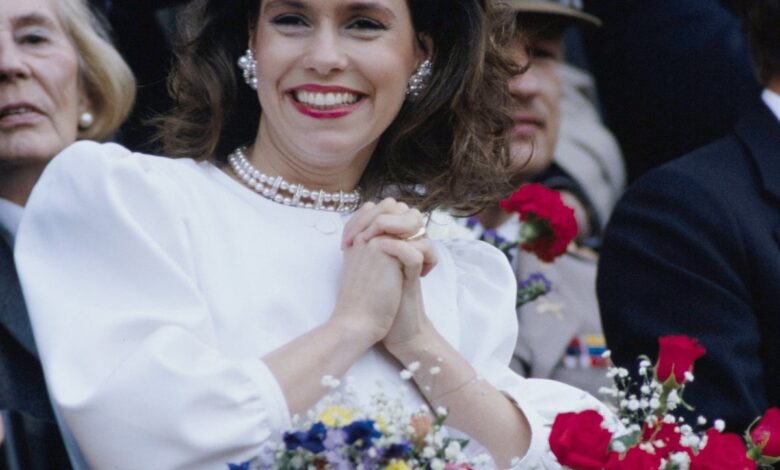
The change of power in the Grand Duchy of Luxembourg, marking the end of Henri’s reign and the accession of his son Guillaume to the throne, became a historic event. Amidst the official celebrations and the presence of representatives from European monarchies and elites, Grand Duchess Maria Teresa shared touching moments from the gala evening on social media. These photos served as a kind of farewell to a role she had fulfilled for a quarter of a century. For a woman of Cuban origin with Spanish roots, it marked the culmination of an incredible journey—one that would have seemed unimaginable for a girl born in Havana in 1956.
She grew up among the influential and affluent Spanish-Cuban bourgeoisie. The Mestre family, to which she belonged, traced its lineage to Spanish nobility, including the House of Espinosa de los Monteros. On her mother’s side, her ancestors are believed to descend from none other than Ferdinand I, King of León and Castile. Her grandfather, Agustin Batista, was the founder of the island’s most powerful bank, the Trust Company of Cuba. The family owned sugar plantations and financial assets, but all of that collapsed overnight with Fidel Castro’s rise to power.
The revolution confiscated all their property, leaving the family facing an uncertain future. Her parents, José Antonio Mestre and María Teresa Batista, made the difficult decision to leave their homeland. Together with little María Teresa, her sister, and two brothers, they went into exile. She was only four years old when they arrived in New York. Later, she would recall how her mother recorded in her diary the child’s question: “When are we going home?”. For her, home was, of course, still Cuba, even though her memories of it were vague.
After five years in America, where she attended prestigious schools, the family moved again. They spent a short time in Santander, Spain, and then finally settled in Geneva, Switzerland. Here her father found work in finance, while her mother devoted herself to raising the children and instilling in them a love for art. Although María Teresa barely remembered Cuba, she always said she kept her “Cuban temperament”—a special warmth, cheerfulness, and rhythm. From her parents she also inherited an important life principle, which she would often express: “If you have received a lot, you must give a lot back.”
It was in Geneva, after obtaining Swiss citizenship and finishing boarding school, that she enrolled at the university to study political science. There, she experienced a meeting that would change her life forever. Her classmate turned out to be Henri, the heir to the throne of Luxembourg. Long hours of studying together developed into a friendship, and then into a deep affection. As she recalls, the more time they spent together, the more it became clear that their destinies were meant to be united.
Their romance was kept secret for a long time. At that time, royal family members were expected to choose their partners from a narrow aristocratic circle. Although Maria Teresa was an educated woman from a noble and wealthy family, she held no title, which became a serious obstacle. Her future mother-in-law, Grand Duchess Joséphine-Charlotte, was strongly opposed to the union. Rumors circulated that Henri was even prepared to renounce his right to the throne just to marry the woman he loved. Ultimately, love prevailed, and in 1980 their engagement was officially announced.
The wedding took place at the Notre-Dame Cathedral in Luxembourg and became one of the year’s major social events. Among the guests were King Olav V of Norway, King Baudouin and Queen Fabiola of Belgium, as well as Prince Rainier III of Monaco with Grace Kelly. Thus, the daughter of Cuban exiles with Spanish heritage became part of one of Europe’s oldest reigning dynasties, opening a new chapter in her remarkable story.