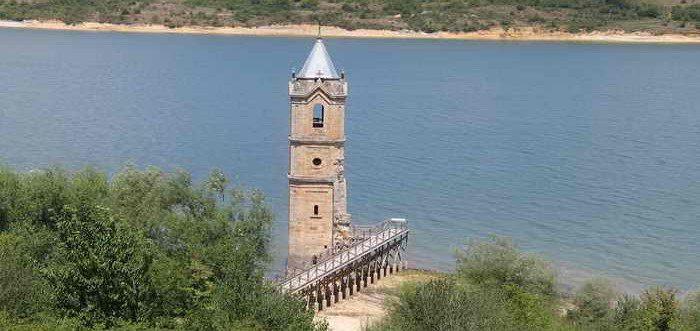
In northern Spain, in the autonomous community of Cantabria, there is a landscape that seems straight out of a fantasy novel. In the midst of a vast stretch of water, a stone bell tower rises like a ghost from the past. It is all that remains of the submerged village of Villanueva de las Rozas and its San Roque church. Locals and travelers have given this place a nickname related to underwater creatures, adding even more mystery to its ambiance.
The story of this striking landscape began in the mid-20th century. In 1952, the construction of a grand hydraulic structure was completed, intended to regulate the flow of the river. However, progress came at a price: entire settlements, such as La Magdalena, Medianedo, and Quintanilla de Bustamante, were lost underwater. Along with houses, fields, and roads, churches and chapels sank to the bottom. Only one building managed to withstand the onslaught of the waters—a tall bell tower from the church in Villanueva de las Rozas. Its height allowed it to remain above the surface, becoming a silent sentinel of sweeping change and human fate.
The church itself was built at the end of the 19th century and served as a spiritual center for the local residents for only a few decades before the hydroengineering project doomed it to eternal silence beneath the water. Years pass, and the water gradually erodes the stonework, but the structure still stands firm. It is especially striking during dry periods, when the water level drops and much of the building is exposed. This resilience and constant coexistence with the aquatic world inspired its poetic popular name.
Today, this place serves as more than just a reminder of a lost world. A wooden bridge over 50 meters long leads to the bell tower, allowing visitors to approach it closely. Inside, a spiral staircase has been preserved, and the bravest can climb to the top. From above, there is a breathtaking view of the entire reservoir, the La-Lastra Peninsula, and the mountain ranges of the Campoo-Los Valles comarca. This corner of southern Cantabria, located at over 800 meters above sea level, attracts visitors with more than just its submerged relic. The surrounding meadows, forests, and shores offer perfect conditions for outdoor activities: from scenic hiking routes to water sports such as kayaking, sailing, and fishing.
The reservoir where the structure stands also holds significant ecological value. This area is recognized as one of the most important wetlands in northern Spain. Since 1983, it has been designated as a Special Protection Area for Birds (ZEPA) and a National Refuge for Waterfowl. As a result, ornithologists and nature enthusiasts flock here to observe birds in their natural habitat. Visiting this place offers a chance to connect with history interwoven with nature, creating something entirely unique. It is a journey that combines the strength of human spirit with the beauty of the Cantabrian landscape, making Villanueva de las Rosas a must-visit destination for those seeking genuine experiences.