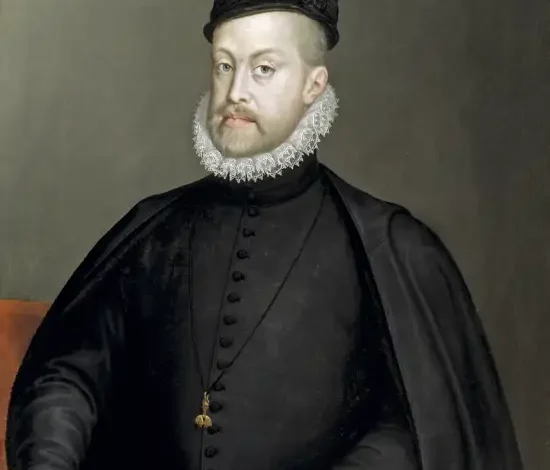
For centuries, the name of the Spanish king Philip II has been shrouded in a grim reputation. Outside Spain, he was portrayed as a despotic and ruthless ruler, guilty of unimaginable crimes. This image, known as the “black legend” (leyenda negra), resulted from one of the most successful propaganda campaigns in history, shaping the perception of both the monarch and the country for generations.
The origins of this information war can be traced to Spain’s political dominance in the 16th century. The power Philip II inherited from his father, Charles V, provoked envy and fear across Europe. While Charles was known as a warrior king, his son, reserved and focused on governing a vast empire from his study, became an ideal target for criticism. His reign coincided with escalating conflicts that his opponents exploited to cast him as a tyrant.
The Netherlands became the main battleground in the struggle for reputation. The uprising against Spanish rule sparked a powerful wave of propaganda. In 1581, rebel leader William of Orange published his famous “Apology” (Apología). In this document, he not only condemned the harsh methods of the Spanish administration but also made personal accusations against Philip II. The king was labeled an adulterer, an incestuous husband (his fourth wife, Anna of Austria, was his niece), and even the murderer of his own son, Prince Don Carlos, and his third wife, Isabella de Valois. These grave and unsubstantiated accusations quickly spread across Europe.
Others also joined the campaign to discredit the monarch. Former royal secretary Antonio Pérez, who fled Spain after his disgrace, published his ‘Relaciones’, portraying Philip II as a vengeful and petty tyrant involved in political assassinations. Portuguese monk José de Teixeira, in his writings, called the Spanish ruler a hypocrite and a monster. Each such work added new, grim shades to the king’s portrait.
The ‘Black Legend’ spread not only through written texts. Visual propaganda played a huge role. In the Netherlands, engravings were mass-produced depicting Spanish soldiers as bloodthirsty barbarians, rapists, and even cannibals. These images were simple, clear, and extremely effective for shaping public opinion. Hatred toward Spaniards became a commodity that sold well, fueling the circulation of such narratives.
Anti-Spanish propaganda found fertile ground in other countries as well. In England, after the failure of the ‘Invincible Armada’ in 1588, a national myth was created about heroic resistance to Spanish tyranny. In France, Spain’s traditional rival, pamphlets circulated ridiculing the imperial ambitions of Philip II. Another powerful tool was the theme of the conquest of America. The work of Dominican friar Bartolomé de las Casas on the brutalities of the conquistadors, translated into many languages, was used to demonstrate the supposed innate cruelty of the Spanish.
The Inquisition became a symbol of Spanish intolerance and fanaticism for Protestant Europe. Philip II, a devout Catholic, actively supported its activities. Stories of torture and auto-da-fé, often highly exaggerated, became an integral part of the ‘Black Legend’, portraying Spain as a land of obscurantism and religious oppression.
Modern historical scholarship offers a more balanced perspective on the character and reign of Philip II. Historians acknowledge that the ‘Black Legend’, while based on some real instances of wartime brutality and political intrigue of the era, was primarily a tool of propaganda. The accusations leveled by Spain’s opponents were often either false or greatly distorted. Today, researchers seek to move past black-and-white assessments and study the figure of the ‘Prudent King’ within the complex context of his era, separating historical facts from centuries-old myths.