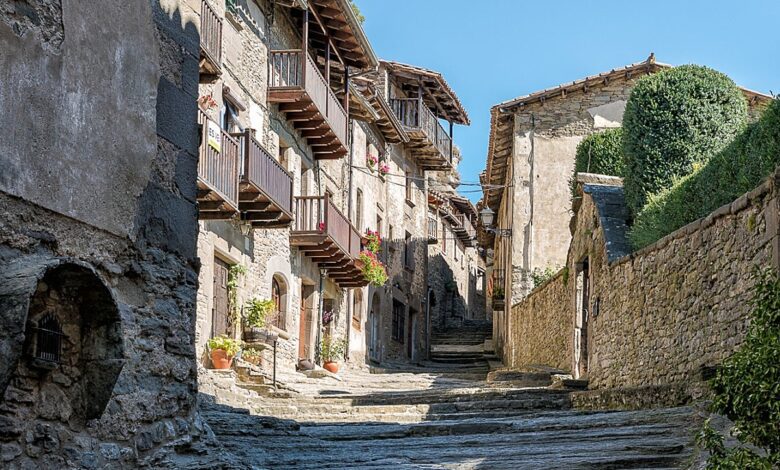
Deep in the Catalan mountains, where cliffs plunge into ravines and forests hide ancient trails, lies Rupit y Pruit — a place where every step echoes the past. This is not just a village, but a true labyrinth of stone, water, and legends that has long drawn those seeking hidden paths and genuine atmosphere. There is no big-city rush here, but you get the sense that time has paused just long enough for you to take in the details: from moss growing on cobblestones to ornate balconies that have witnessed centuries.
Rupit’s main pride is its suspension bridge, built in 1945. It not only connects the riverbanks, but also symbolizes a passage between eras. Everyone who dares to cross its planks feels a slight thrill: below, the river roars, surrounded by sheer cliffs and dense thickets. The bridge has become an integral part of the local landscape and one of the region’s most photographed landmarks. Yet, it’s not the only thing that draws travelers here. Narrow cobblestone streets lead to houses with wooden shutters, still home to descendants of those who built these walls centuries ago.
Historic routes
At the center of the village stands Caballeros Square—once a meeting place for the nobility, now a point of attraction for visitors. From here begins the path to the ruins of an ancient fortress that once protected residents from raids. The remaining walls and towers are reminders of times when every meter of land had to be defended. Nearby is the Church of Saint Michael the Archangel, built in the 13th century. Its Baroque altar and 18th-century bell tower still draw both pilgrims and architecture enthusiasts.
Plaza Mayor is the heart of community life. Here you’ll find the town hall, the school, and historic mansions with Gothic windows. From the hill, there’s a view of the chapel of Santa Magdalena, perched on a cliff and surrounded by a rushing river. Built in the 17th century, this chapel combines elements of Romanesque style with a unique atmosphere of solitude. Water plays a special role here: the river that crosses the village once powered the local mills. Most of them were destroyed by the flood of 1940, but Marandes—a flour mill from the 17th century—survived and operated until 1962.
A Taste of Tradition
The road to Pruit leads to the Church of Saint Andrew, standing almost a kilometer above sea level. Its walls have collapsed more than once due to earthquakes, but each time, residents rebuilt the temple using local stone. The village proudly preserves its gastronomic heritage: at Forn de Pa l’Era, bread is still baked according to ancient recipes, and market stalls feature homemade cheeses, sausages, honey, and the famous Catalan liqueur ratafia. Here, there’s no rush: buying bread is a cherished ritual, and a conversation with the shopkeeper is a source of news and advice.
Rupit y Pruit is not the only corner of Catalonia where history and nature intertwine so closely. In nearby Girona, there’s a village that also impresses with its location and atmosphere. This story explores how medieval walls and dramatic events can turn an ordinary place into a tourist legend, as seen in the tale of the castle with a tragic history in Andalusia. Stories like these invite us to see Catalan and Andalusian villages in a new light—not just as beautiful backdrops, but as living monuments to human resilience and imagination.
The power of nature
The surroundings of Rupit y Pruit are a true paradise for hiking enthusiasts. Dozens of trails lead to waterfalls, viewpoints, and secluded valleys. The Collsacabra forests are home to rare plants, and in spring the hillsides bloom with carpets of flowers. Locals take great care of their environment: tourists are asked to stay on paths, not to leave trash behind, and to respect the peace and quiet. This is where the village’s special magic lies—here, everyone feels part of something vast and fragile.
Rupit y Pruit is more than just a spot on the map—it’s a place where past and present merge into one. It’s easy to lose track of time here, to dissolve into the silence, and to let yourself pause. For many travelers, this village is a revelation: true Catalonia lies not just in Barcelona, but in small towns where every stone holds its own story.
Rupit y Pruit is a unique village in the province of Barcelona, bringing together two historic centers. Its suspension bridge, built in the mid-20th century, has become a symbol of connection and overcoming barriers. The village is renowned not only for its architecture but also for its preserved crafts, traditions, and special respect for nature. Locals take pride in their heritage and actively participate in community life, maintaining ancient customs and welcoming new visitors. Thanks to its blend of natural beauty and historic authenticity, Rupit y Pruit remains one of the most striking examples of rural Catalonia, where the past holds equal ground with the present.