In the very heart of Salamea de la Serena stands a structure that does more than simply adorn the town square—it truly transforms how we see Spain’s past. This Roman monument, unique across the entire Iberian Peninsula, has become a symbol not only of architectural mastery but also of a mysterious fate full of dramatic transformations. Its appearance in the urban landscape posed a real challenge for researchers and tourists alike, as behind its austere lines lies a story worthy of a novel.
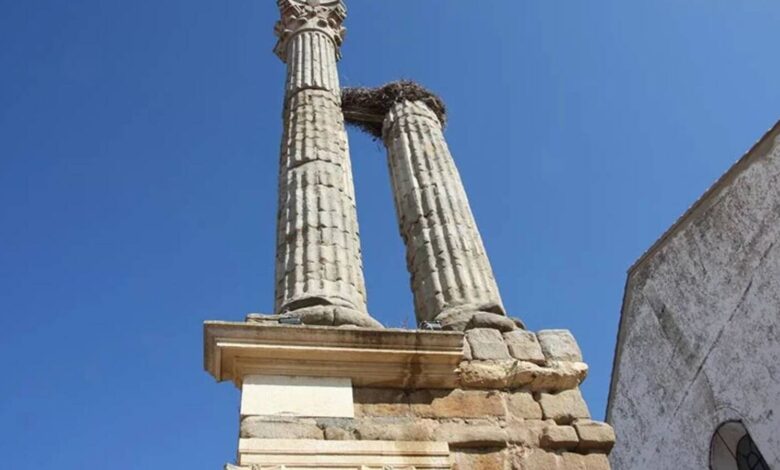
The height of this monument is astonishing: over 23 meters of granite laid in perfect rows, seemingly defying the passage of time. Known locally as the Distilo, it was erected in honor of Emperor Trajan, back when the city was called Iulipa. But fate took another turn: for centuries, the monument was hidden from view, built into a church bell tower, and only in the 20th century was it brought back to life. The architects who restored it painstakingly reconstructed its form piece by piece, stripping away later additions and restoring its original grandeur.
The symbolism of this structure goes far beyond that of an ordinary monument. Its architectural composition—two slender columns crowned with Corinthian capitals standing on a massive podium—has no equivalents in Spain. The entire construction rests on a rock, giving it exceptional stability and monumentality. An inscription preserved on the entablature still sparks debate among experts: to whom exactly was this monument dedicated, and what role did it play in the life of the ancient city?
A hidden history
For a long time, the Distilo remained part of church architecture, and only in the 1960s did large-scale restoration begin. The work was led by renowned architects who decided to restore the monument’s independence by removing all later additions. This move stirred heated debates among locals: some believed the monument should remain part of the church, while others insisted on its historical value as an independent site. In the end, science prevailed, and today the Distilo can once again be seen in all its ancient splendor.
The unusual fate of the monument reminds us how often history intertwines with the present. Spain has many places where the past comes alive before our eyes, and each of these sites becomes a source of new discoveries. For example, in Andalucía, there is a castle where real-life dramas inspired writers to create immortal works— the legends of passion and betrayal within the ancient walls of Arjonilla still captivate the imagination of travelers.
An Architectural Enigma
Distilo impresses not only with its scale, but also with its ingenious technical solutions. The columns, more than ten meters high, are crafted from solid granite blocks—an unusual feature for Roman architecture on the Iberian Peninsula. The capitals are adorned with intricate carvings, while the austere entablature preserves traces of an ancient inscription that researchers are still striving to decipher. All this makes the monument a subject of close attention for both historians and architecture enthusiasts.
In 1931, the monument was granted national heritage status, opening the way for systematic study and restoration. Since then, it has become a key element of the region’s cultural legacy, and its image is often featured in tourism materials about Badajoz and all of Extremadura. Every year, thousands of visitors come here to see this unique site, which has survived the centuries while retaining its mystery.
Heritage and Modernity
Today, Distilo is not just a historical site but a symbol of renewed interest in Spain’s Roman past. Its story is a testament to how ancient monuments can capture the imagination of new generations, inspiring them to study and preserve cultural legacy. Guided tours are held regularly around the monument, and locals take pride in their city’s role as guardian of this unique Roman heritage.
In recent years, interest in the Distilo has only grown. Archaeologists continue their research, and tourists are increasingly adding Salamea de la Serena to their travel itineraries. The monument has become an integral part of city life, and its history is a source of pride and inspiration.
The Distilo de Salamea is more than just an architectural structure—it’s a true symbol of the era when Spain was part of the great Roman Empire. Its uniqueness lies not only in its size and technical execution, but also in its remarkable journey: from monumental tombstone to part of a church tower, and finally, an independent monument. Today, it stands as a reminder of the importance of preserving our connection to the past and valuing the heritage that has come down to us through the ages.