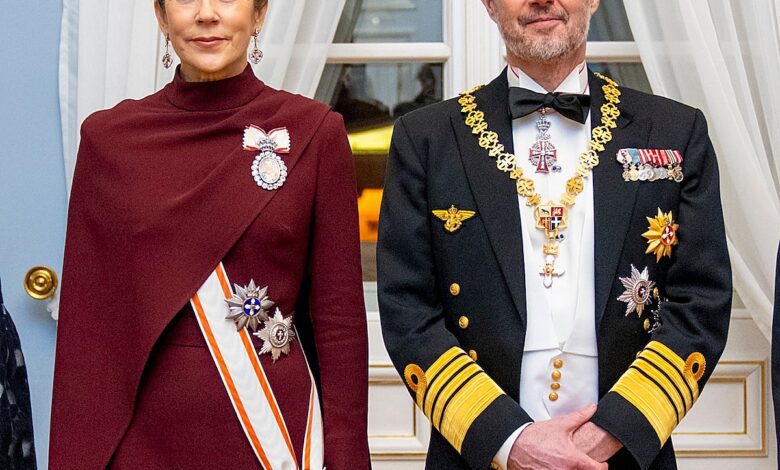
Queen Mary’s appearance with an unusual tiara at official events has caused a real buzz among European royalty enthusiasts. Her unexpected move—purchasing the piece at auction rather than inheriting it through tradition—sparked widespread discussion in Danish society and beyond. This decision not only highlighted Mary’s independence but also became a symbol of change within the royal family, where personal choice is taking on an increasingly important role.
Unlike most royal women, Mary didn’t limit herself to family heirlooms. During her visit to the Baltic States, she showcased several pieces of jewelry, each with its own story. The tiara that especially stood out was one Mary bought at a Danish auction, turning it into a personal treasure. This piece, which can be transformed into a necklace and is accompanied by earrings, became not just a fashion statement but also a challenge to established traditions.
Personal choice
In Estonia, Mary wore a tiara that had belonged to Queen Margrethe, while in Lithuania, she was seen with that very auction gem, a piece not found in the traditional royal wardrobe. The purchase of this set in 2012 came as a surprise: for 9,000 euros, Mary acquired an Edwardian ensemble of pink diamonds, rubies, and spinels set in gold and silver. The price doubled the starting bid, fueling even more curiosity about the lot and its new owner.
Since its purchase, the piece of jewelry has undergone several transformations. It first appeared on Mary’s neck as a necklace, and a year later—already reimagined as a tiara. The Queen didn’t stop there and commissioned new earrings to complete the set. Such a thoughtful approach to personal style has become rare among royals, where every detail is usually strictly regulated.
New traditions
Mary’s boldness in her choice of jewelry didn’t end with a single purchase. She actively collaborates with artisans from the Royal Collection to create modern interpretations of classic forms. In 2024, her collection was joined by a bandeau tiara crafted from diamonds that once adorned a medieval belt. This approach to heritage is an attempt to bridge past and present without losing individuality.
The Danish royal wardrobe is renowned for its heirlooms, many of which date back centuries. Yet Mary has managed to bring a fresh perspective, enhancing tradition with personal touches rather than breaking with it. Her jewelry becomes not just part of official ceremonies, but also a reflection of the Queen’s inner world.
Challenging convention
Mary’s actions provoked a mixed response among monarchy enthusiasts. Some saw it as a sign of independence and a modern approach; others viewed it as a break with age-old customs. Nevertheless, these decisions are precisely what shapes the new face of royal households, where individuality comes to the fore and traditions become more flexible.
Such stories are rare in European royal circles. Typically, jewelry is passed down through generations, and its selection is strictly regulated. Yet Mary has shown that even in a world bound by tradition, there is room for individuality and creativity. Her example inspires not only fashion enthusiasts but also those who value the courage to stand by one’s beliefs.
Queen Mary
Mary, originally from Australia, became the wife of King Frederik and one of the most prominent figures in modern European monarchy. Her path into the royal family was marked not only by adapting to new traditions but also by her desire to bring something of her own. Thanks to her personal taste and bold decisions, Mary has earned respect both in Denmark and beyond. Her jewelry collection reflects her character, combining respect for history with a drive to move forward. Personalities like hers are reshaping the image of 21st-century monarchies.