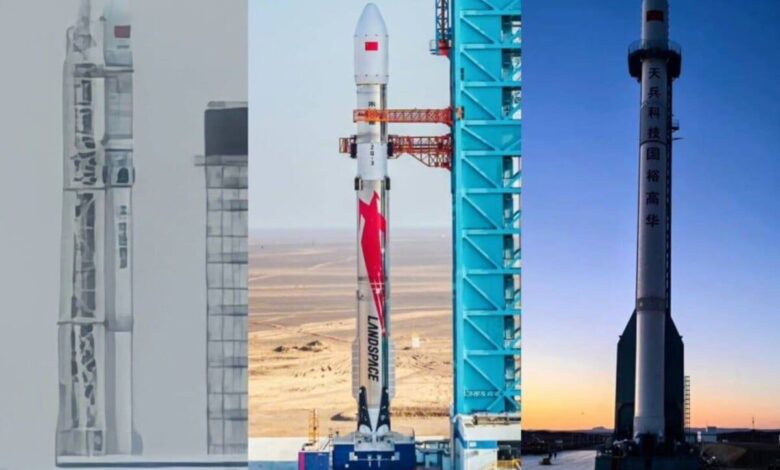
China is finalizing preparations for the launch of three cutting-edge reusable rockets, each poised to reshape the competitive landscape of the space services market. The Long March 12A, Zhuque-3, and Tianlong-3—developed by both state-owned and private companies—are already stationed on their respective launch pads. Their primary mission is to enable the large-scale deployment of satellites for national internet constellations and to provide a cost-effective alternative to foreign launchers by slashing launch costs and speeding up reusability.
Long March 12A and Zhuque-3 are scheduled for their maiden flights as early as December. Both rockets are tasked with not only deploying payloads into orbit but also successfully returning their first stages, landing approximately 400 kilometers from the launch site. While Tianlong-3 was also designed for reusability, its first flight will not include an attempt to recover the booster.
According to engineers familiar with the project, the readiness level of the Long March 12A matches that of the Zhuque-3. Industry insiders continue to debate which vehicle will be the first to attempt China’s historic first booster landing—a milestone that could mark a turning point for the country’s entire space program.
China bets on reusability and competition
All three rockets were developed with a focus on reusability, a strategy aimed at significantly reducing launch costs and increasing flight frequency. This approach has already proven successful for American companies, and now China is determined not only to catch up with, but to surpass, its international rivals.
Particular attention is focused on Zhuque-3, developed by the private company LandSpace. In October, the launch vehicle successfully passed fueling and static fire tests at the Jiuquan launch site. However, the launch had to be postponed due to an incident involving the crewed spacecraft Shenzhou-20 at the Tiangong orbital station in early November. The launch is now scheduled for the last weekend of the month.
Long March 12A, developed by a state-owned enterprise, is also set for a December launch. If successful, both rockets could not only propel China to the forefront in the number of commercial launches, but also strengthen the country’s position in the global space services market.
Technological Features and Prospects
Each of the three rockets has its own technical characteristics. Long March 12A and Zhuque-3 are designed to return their first stages using controlled landings—a practice not previously implemented in China. Despite its reusable design, the first flight of Tianlong-3 will focus solely on delivering the payload into orbit.
Experts note that successful implementation of these projects will allow China to create its own satellite constellations to provide internet services nationwide and abroad. In addition, the new launch vehicles could attract foreign customers seeking reliable and cost-effective solutions for deploying satellites into orbit.
In the coming months, experts will closely watch the results of the first launches. The success of these missions will determine the future of China’s space industry and its ability to compete with the world’s leading players.
Inside the Industry: The Race for Leadership
Within the professional community, debates continue over which launch vehicle will successfully land its first stage first. This achievement will mark not only a technological milestone but also symbolize a new era in the development of Chinese space technology. If successful, China will be able to offer services comparable in quality and cost to American and European counterparts.
At the same time, work is underway to improve control and safety systems to ensure maximum reliability for reusable launches. Engineers note that each rocket has undergone a series of tests confirming their readiness for real-world operations.
China is expected to significantly increase the number of commercial launches in the coming years, with new reusable launch vehicles forming the foundation for the further advancement of the national space program.
By the way, about LandSpace
LandSpace is one of China’s first private aerospace companies, founded in 2015 in Beijing. The company specializes in developing and manufacturing next-generation launch vehicles for the commercial market. LandSpace became well-known with its Zhuque-1 project, China’s first private rocket, which launched in 2018. Despite the initial setback, the company pressed forward and soon unveiled the more advanced Zhuque-2, which became the world’s first methane-fueled rocket to successfully reach orbit. Today, LandSpace actively competes with state-owned giants and other private players as it seeks leadership in both domestic and international markets. Its achievements have attracted the attention of investors and experts worldwide, while new projects like Zhuque-3 further demonstrate the company’s high level of technological ambition.