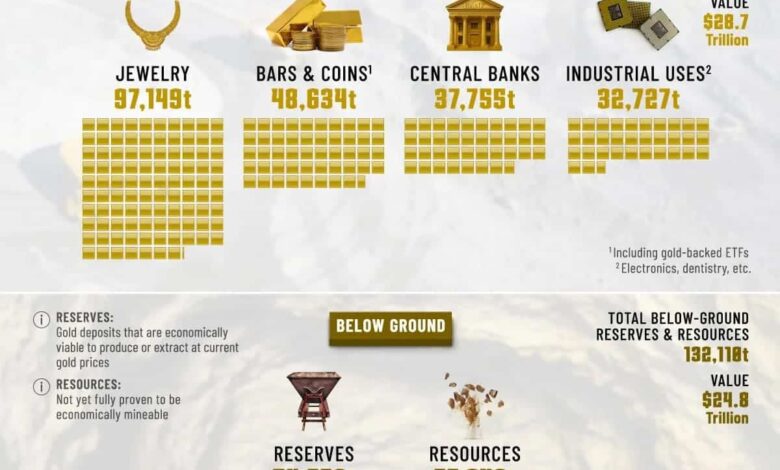
For centuries, gold has remained a symbol of wealth, power, and stability. In 2024, its global reserves have reached impressive levels, and their distribution among countries and sectors clearly shows how this precious metal shapes both the economy and culture. A new infographic, based on the latest data, reveals where all the world’s gold is concentrated and how it is utilized.
Jewelry holds the leading position among all categories, accounting for 97,149 tons—nearly half of all the gold ever mined by humanity. In India and China, gold jewelry is more than just a luxury item; it is a part of national identity and an essential element in many rituals. In 2024, India once again became the largest buyer of gold jewelry, purchasing 560 tons, while China ranked second with 510 tons. In these countries, gold accompanies people from birth to marriage and even after death, underscoring its unique significance in culture and tradition.
However, jewelry is not the only fate for gold. A significant portion of the metal is stored as bars, coins, and in gold-backed exchange-traded funds. The total volume of these assets stands at 48,634 tons. This demand is driven by investors seeking to protect their savings from inflation and economic upheavals. Gold has traditionally been seen as a ‘safe haven’ for capital, especially during periods of financial market instability.
Gold in national reserves: Who leads the way
Central banks worldwide continue to increase their gold reserves, regarding them as a strategic asset. As of the end of 2024, the largest reserves are concentrated in the United States, Germany, and Italy. The American reserves remain unmatched by other countries, reinforcing the global dominance of the dollar. Germany and Italy also traditionally rank among the top three, using gold as a tool for financial stability and trust in their national currencies.
Overall, central banks hold 37,755 tons of gold in reserves. This is less than private investors and jewelry companies possess, but the role of state reserves cannot be overstated. During crises, these reserves serve as the ultimate guarantee of solvency and economic stability.
Interestingly, recent years have seen a trend toward increasing gold reserves in Asian and Middle Eastern countries. China, India, Turkey, and Russia are actively buying gold to reduce their dependency on the dollar and strengthen their national currencies. This shift in global reserves reflects broader changes in the balance of power worldwide.
Industrial gold: technology and innovation
Gold plays an equally important role in industry. In 2024, 32,727 tons were used for technological purposes. This metal is irreplaceable in electronics, where it is used to coat contacts and connectors thanks to its high conductivity and resistance to corrosion. Modern smartphones, computers, and even spacecraft would be unimaginable without gold.
In addition to electronics, gold is also used in dentistry, medicine, and several other industries. Its biological inertness and unique physical properties make it highly sought after for producing implants, prosthetics, and advanced medical devices. In recent years, interest in using gold in nanotechnology and new materials has been growing, opening up additional opportunities for the sector’s development.
Industrial demand for gold, while smaller than that of jewelry and investment, continues to grow as technology advances. This puts additional pressure on the market and affects the price of the metal.
Global trends and cultural factors
The global gold market is influenced by a range of factors, from economic crises to cultural traditions. In some countries, gold is still seen as a reliable way to preserve and pass on wealth from one generation to the next. In others, it has become an investment asset and a subject of speculation on exchanges.
In 2024, demand for gold in the jewelry sector remains consistently high, especially in Asia. At the same time, interest is growing in gold-linked investment instruments, reflecting investors’ concerns about inflation and geopolitical risks. Central banks continue to diversify their reserves, increasing the share of gold in their portfolios.
Technological innovations also contribute to demand structure. New uses for gold emerge every year, sustaining interest in the metal even amidst high price volatility.