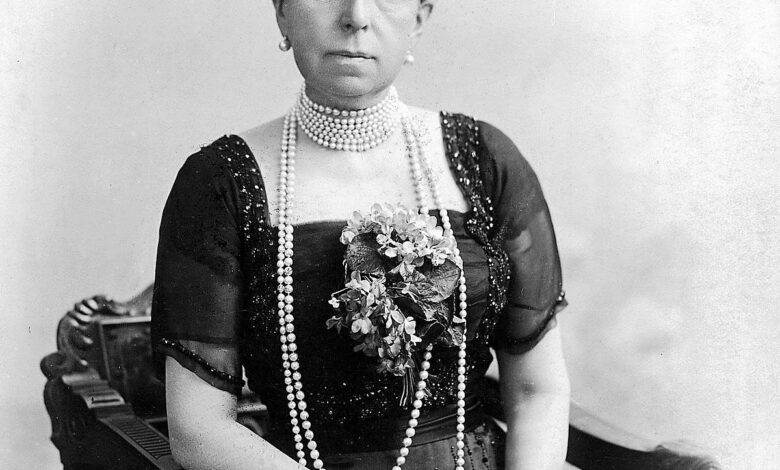
The Spanish royal family’s treasury housed many unique pieces of jewelry. Among them stood out a magnificent necklace adorned with sapphires and diamonds, once belonging to Queen María Cristina of Austria. This heirloom, a wedding gift from her Habsburg family when she married King Alfonso XII on November 29, 1879, is no longer part of the Spanish crown’s collection today.
Queen María Cristina often appeared in public wearing this necklace, as documented in numerous photographic portraits of the era. After her death, the necklace was inherited by her son, King Alfonso XIII. He decided to present it as a wedding gift to his daughter-in-law, the Franco-Italian aristocrat Emanuela de Dampierre y Ruspoli, who was marrying his second son, Infante Jaime, Duke of Segovia, who was hearing impaired.
The wedding of 22-year-old Emanuela and Jaime de Borbón took place in Rome in 1935. The ceremony was held at the Church of Sant’Ignazio di Loyola. The bride wore a silver lamé gown crafted by Italian designers Sorelle Botti, and her head was adorned with a tiara, also a gift from Alfonso XIII. It was at this moment that Emanuela became the owner of several family jewels, including the famed sapphire necklace and the diamond floral tiara.
The necklace itself was a true work of art, crafted by Austrian jeweler Biedermann in the mid-19th century. It was made up of ten plaques, each set with a large oval-cut sapphire surrounded by a cluster of antique-cut diamonds. The plaques were connected by diamond-studded links. The design of the piece was strikingly modern for its era, while the deep blue hue of the stones made it particularly valuable. Its construction allowed the necklace to be adjusted in length or even converted into two separate bracelets.
In addition to this masterpiece, Emanuela received a diamond rivière necklace, a strand of white and black pearls, a rock crystal brooch, and other valuables. However, the marriage of the Duke and Duchess of Segovia did not last, and they divorced in 1947. Over time, Emanuela began selling off the jewels she had received. The sapphire necklace was put up for auction several times, the most recent being in Paris in 2014. Since then, its whereabouts remain unknown. The same fate befell her floral wedding tiara, the destiny of which is also a mystery.
Jaime and Emanuela had two sons: Alfonso, Duke of Cádiz, and Gonzalo, Duke of Aquitaine. Infante Jaime, who was born deaf, renounced his rights to the Spanish throne as early as 1933, but later became the Legitimist pretender to the throne of France. Today, this title is held by his grandson, Luis Alfonso de Borbón.
Notably, Queen María Cristina of Austria (María Cristina de Habsburgo-Lorena) was a prominent figure in Spain’s history. She became the second wife of King Alfonso XII, and their marriage was intended to strengthen the monarchy. After her husband’s sudden death from tuberculosis in 1885, she was appointed regent while pregnant. A few months later, she gave birth to a son, the future King Alfonso XIII, and governed the country on his behalf until he came of age in 1902. Her regency was an extremely challenging period for Spain, marked by major internal political crises, the rise of anarchism, and growing labor movements. The most significant foreign policy shock was the Spanish–American War of 1898, a defeat that resulted in the loss of the last major colonies: Cuba, Puerto Rico, and the Philippines. Despite these hardships, María Cristina proved to be a wise and prudent political leader. She managed to preserve the throne for her son and maintain stability during the transition. She was respected for her tact, sense of duty, and ability to find compromises. María Cristina remained an influential figure at court even after handing power to her son, up until her death in 1929.