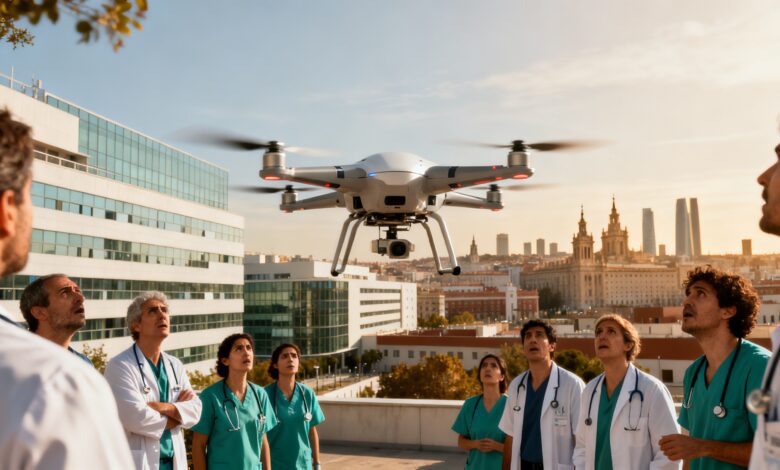
In the coming years, Madrid could become one of the world’s leading hubs for drone integration. Regional authorities have allocated 16 million euros for a large-scale program that is already impacting the daily lives of the capital’s residents. The main priorities include the creation of specialized drone airports, the launch of a testing facility, and the simplification of bureaucracy for businesses. These measures have the potential to transform transportation, healthcare, and safety across the region.
Technology for everyday life
Madrid is currently running more than ten projects involving drones across various sectors. In healthcare, drones are already being tested for urgent deliveries between hospitals—such as for medications and blood. This method of transportation helps bypass traffic jams and saves precious minutes, which can sometimes be critical for saving lives. According to RUSSPAIN.COM, a successful demonstration took place last year between La Paz and Carlos III hospitals: a drone covered the route in three minutes at an altitude of about 30 meters, allowing experts to assess the prospects for mass adoption of these solutions.
Drones are also widely used for infrastructure maintenance. Canal de Isabel II employees use them to inspect underground utilities, identifying defects and preventing accidents. With the help of artificial intelligence and high-resolution imaging, experts obtain a comprehensive picture of tunnel conditions—the network stretches over 2,500 kilometers.
Control and security
In the fields of ecology and urban planning, drones help monitor compliance with construction regulations and detect illegal settlements along rivers. They collect data for inspections and reporting violations. Additionally, drones are used for topographic surveys, monitoring the state of natural ecosystems, and supporting agricultural research.
In areas where residents have faced power outages for several years, authorities are testing drones equipped with thermal cameras. These devices allow the creation of heat maps and an analysis of how comfortable homes are in the absence of stable heating. This approach helps make decisions on housing support and repairs.
Emergency services and training
Drones have become indispensable assistants for rescue services and police. They are used to search for missing people at night or in challenging weather conditions, to fight forest fires, and to monitor large crowds at mass events. This enhances safety and speeds up response in emergencies.
The transport and construction sectors are working to create a regulatory framework for new technologies. Experts are analyzing what powers the region could obtain in the future to oversee drone usage and develop infrastructure. At the same time, educational institutions are launching new courses on drone operation, while employment centers are offering training for those looking to work in this rapidly growing field.
New horizons
Madrid is not limiting itself to current projects. Authorities take an active role in working groups on regulation, infrastructure, and safety, and also support events dedicated to advancing air mobility. In the coming years, new initiatives are expected that could position the region as a leader in drone technology not only in Spain but also across Europe.
In recent years, Spain has increasingly become a platform for innovation in unmanned technology. In 2025, large-scale tests of medical cargo delivery drones took place in Barcelona, while Valencia trialed forest fire monitoring systems using drones. These projects demonstrate growing interest in drones nationwide, with regions competing for leadership in emerging technologies.