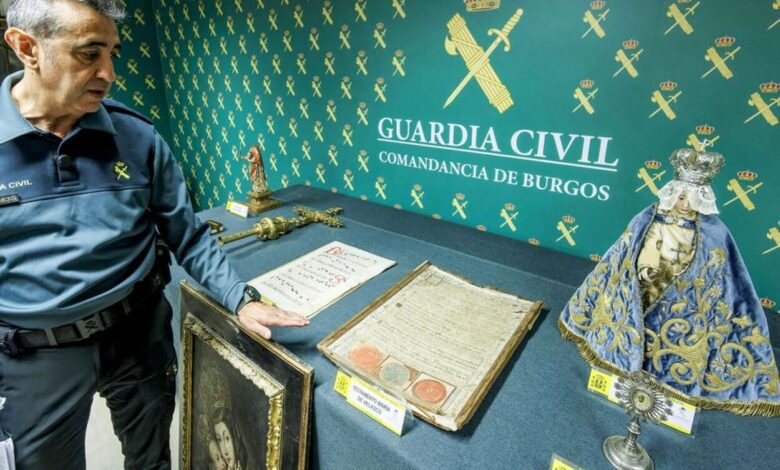
In the city of Orduña, officers from the Guardia Civil have seized thirty unique works of art that were previously removed from the Belorado monastery and, according to investigators, were destined for illegal sale. Among the recovered relics are antique paintings, carved figures, crosses, manuscripts, books, and miniature statues, all of significant historical and cultural value.
All of these pieces were discovered in one of Orduña’s monasteries. According to preliminary expert estimates, the collection could be worth tens of thousands of euros. Some of the items have already been returned to Burgos, while the rest remain temporarily impounded for further study and preservation.
Experts note that most of the artifacts require careful analysis, restoration, and subsequent cataloging. Two 17th-century paintings, believed to have been created by the same artist, have drawn particular attention. One depicts the stigmata of Saint Francis, while the other shows the image of the Immaculate Virgin Mary.
Rare discoveries
Among the most valuable exhibits is a 14th-century sculpture of Christ. Although the cross to which it is attached was crafted later, the figure itself retains features of the medieval school. Another discovery is a will dated 1556, believed to have been composed by Abbess María de Velasco. The document was found in one of the monastery cells in Orduña.
Particular interest was sparked by a wooden polychrome statue of the Virgin Mary, known as ‘Señora de la Bretonera’ (Nuestra Señora de la Bretonera). This 16th-century work was previously housed in the Belorado monastery, which gave the statue its name. The statue’s garments were likely made in the 20th century and are decorated with gold embroidery.
Investigation progress
The investigation began with a routine inspection of the antiques market conducted by officers of the Guardia Civil. During this monitoring, they identified one of the missing relics, which led them to the Belorado and Orduña monasteries. As a result of their operations, searches were carried out in both monasteries, where all thirty items were found.
According to investigators, the nuns who left Belorado intended to sell these works of art on the illegal market. The operation resulted in the seizure of the collection and prevented its potential sale abroad.
Cultural significance
The recovered items are not only of material but also great historical value. Many are linked to the life and legacy of the Belorado monastery, which for centuries was an important spiritual and cultural center in the region. Experts emphasize that such discoveries offer deeper insight into the history of religious art in Castilla y León.
In the near future, all recovered relics will undergo identification and restoration. Afterwards, they will be transferred to state museums or returned to the monastery if it ensures their preservation.
In case you didn’t know, the Guardia Civil is one of Spain’s oldest law enforcement agencies, founded in the 19th century. Beyond maintaining public order, it also protects the nation’s cultural heritage. In recent years, the agency has repeatedly thwarted attempts to illegally export historical treasures, returning unique works of art to Spain’s national collections.