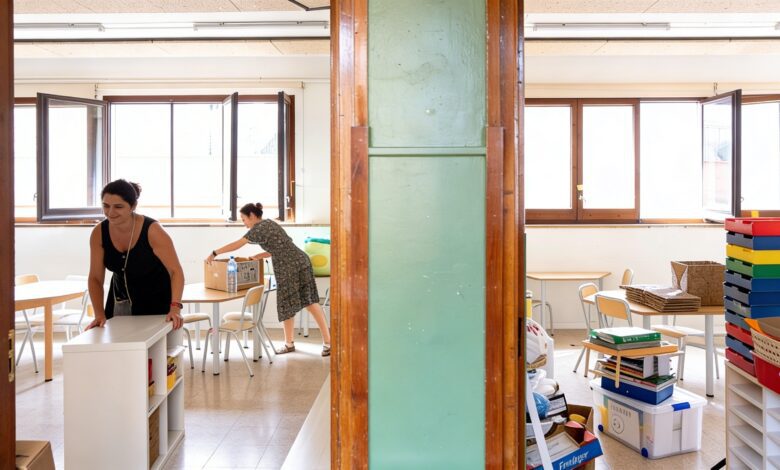
In Catalonia, schools and lyceums are increasingly forced to rely on help from parents and private organizations to provide basic learning conditions. Last academic year, educational institutions in the region received donations totaling about €300,000, signaling a clear lack of public funding. According to El Pais, most of these funds came from students’ families and parent associations (AFA), as well as from individuals and foundations. Donations included not only equipment and furniture but also specialized devices, such as a medical diagnostic machine.
Among the gifts schools received from companies and foundations were computers, tablets, laboratory instruments, sports equipment, and even unusual items like an echo scanner or a paraffin dispenser. The total value of these items was around €82,000. The remaining amount was distributed as money transfers, ranging from several hundred to €24,000 at a time. Schools use these funds for repairs, purchasing additional equipment, classroom ventilation, or organizing field trips — opportunities many students would not have otherwise.
The role of families and foundations
Parent associations (AFA) have become a key source of support for many schools. According to the president of one such organization in the Baix Llobregat area, families are forced to take on expenses that by law should be covered by the state. For example, AFA recently purchased tablets for the school because the old computers could no longer handle the tasks and there was no budget funding. However, these initiatives sometimes spark debates: not all parents agree with buying devices, especially given screen time restrictions in lower grades.
Foundations are also actively involved in supporting education. The Bosch Aymerich Foundation, for example, allocated almost €88,000 to help schools and high schools in the Cerdanya region. The funds went to organizing trips to ski resorts, covering transportation costs, and providing insurance for students. According to the foundation’s manager, this support almost doubled the number of children able to take part in sports. In addition, the foundation assisted with repairs of educational facilities, which became significant support for schools.
Systemic problems
The situation with donations exposes the chronic underfunding of public schools. According to El Pais, many principals prefer to seek help from parents rather than the Department of Education, as it is quicker and easier. However, this practice leads to inequality: not all parent associations have the same resources, and the gap between schools continues to widen. Representatives of Affac, which unites the AFAs of public schools, believe this system undermines the principle of free education and shifts responsibility from the state to families.
A study by Affac, conducted back in 2019, showed that 89% of parent associations make regular contributions to schools—both as financial support and materials. On average, each AFA provides about €4,000 per year, with total donations reaching €4.3 million. In addition, families pay around €100 every year for school supplies and field trips, creating an extra burden on household budgets.
Consequences for the system
The problem of education funding in Spain is not limited to Catalonia. Other regions have also reported cases where parents are forced to buy equipment, pay for repairs, or even provide schools with furniture. According to russpain.com, this situation can also be seen in Madrid, where recent years have seen an increase in private donations to public schools. As a result, the quality of education increasingly depends on the financial capacity of families rather than on government efforts.
The question of the role of private funds in education financing is becoming more pressing amid other changes in social policy. For example, authorities recently tightened control over properties owned by foreign states and private companies, as discussed in detail in an article about new security measures against the backdrop of rising international tensions. These developments reflect a general trend: the government is increasingly shifting some of its responsibilities to the private sector and individual citizens.
In recent years, Spain has repeatedly debated the fairness of how budget funds are allocated between regions and sectors. In 2024, cases were reported in Valencia and Andalusia where schools received major donations from local businesspeople and foundations. In Murcia and Galicia, parents organized fundraising drives for gym repairs and to buy textbooks. These examples show that the issue is not confined to a single area and requires a systematic solution at the national level.