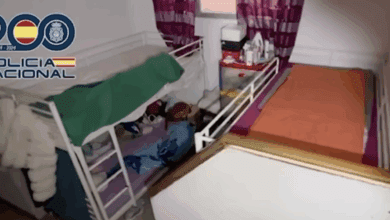
Incidents at one of Madrid’s abandoned complexes have once again raised concerns about safety in the capital and how quickly criminal schemes can escalate into real threats to life. The court’s decision in this case has sent an important message to city residents: even a routine transaction can end in tragedy if risks are ignored.
In January 2024, as reported by El Pais, two men and a woman set a trap for potential car buyers. The meeting, arranged on the outskirts of the San Blas district, was supposed to be a simple handover of cash for a Mercedes. However, events unfolded differently: instead of a deal, the victims were taken hostage at a notorious narco-hotel, where tragic incidents had happened before.
Hostage-taking and threats
Immediately after arriving at the meeting point, David M. and his uncle, Jose Antonio V., were ambushed by armed assailants. They were taken to one of the derelict rooms, robbed of their cash and phones, and their BMW was also seized. The perpetrators demanded the victims’ relatives urgently collect a large sum—80,000 euros—threatening violence and even death.
For 36 hours, David and his uncle were under constant pressure. They were threatened, not allowed to leave the premises, and all attempts to negotiate failed. In the end, the family managed to put together only part of the demanded sum — €14,000, which was handed over through an acquaintance in San Fernando de Henares. But the extortion did not stop there: the criminals demanded another €100,000, and the second money drop took place at night on the A2 highway, where David’s wife was able to raise €80,000.
Police operation
Police had already been monitoring the criminals’ actions and had pre-marked some of the banknotes with special signs. After the second handover, when the hostages were released, officers arrested five suspects in a car, where they found a bag containing the marked money. The court found Ramón S. and Ibragim E. guilty of kidnapping and robbery, sentencing them to 11 years in prison each. Dolores de los Ángeles J. received three and a half years as an accomplice. The court also considered the mental state of one of the accused, which affected the length of the sentence.
Three others, detained along with the main suspects, were acquitted due to lack of evidence of their involvement. As El Pais notes, the case sparked a strong reaction in Madrid and prompted discussion about measures to prevent such crimes in the future.
Context and consequences
This case is not an isolated incident in the series of high-profile crimes involving abductions and extortion in Spain. In recent years, police have reported an increase in such incidents, especially in major cities. For example, a repeat offender linked to extremist groups was recently detained in Melilla, raising further concerns among security experts. Details about similar arrests can be found in the report on the repeat arrest of a recruiter in Melilla.
Overall, such stories highlight the need for greater attention to personal safety and vigilance when making deals, especially in unfamiliar places. Abandoned buildings and complexes, as the case of the narco-hotel in Madrid demonstrated, often attract criminal elements. Authorities continue their efforts to uncover and stop such schemes, though experts believe that only joint action by police and the public can reduce the risk of similar tragedies in the future.
In recent years, Spain has seen a rise in kidnappings for ransom, particularly in major cities and their outskirts. Police report that criminals are increasingly using abandoned buildings to hold victims, making detection more difficult. In 2025, a similar case was uncovered in Barcelona, where the victim was held in an industrial area and a ransom was demanded from their family. Analysts link the increase in such crimes to economic difficulties and the activities of organized groups. Authorities are tightening control over abandoned properties and developing new measures to prevent such incidents.